
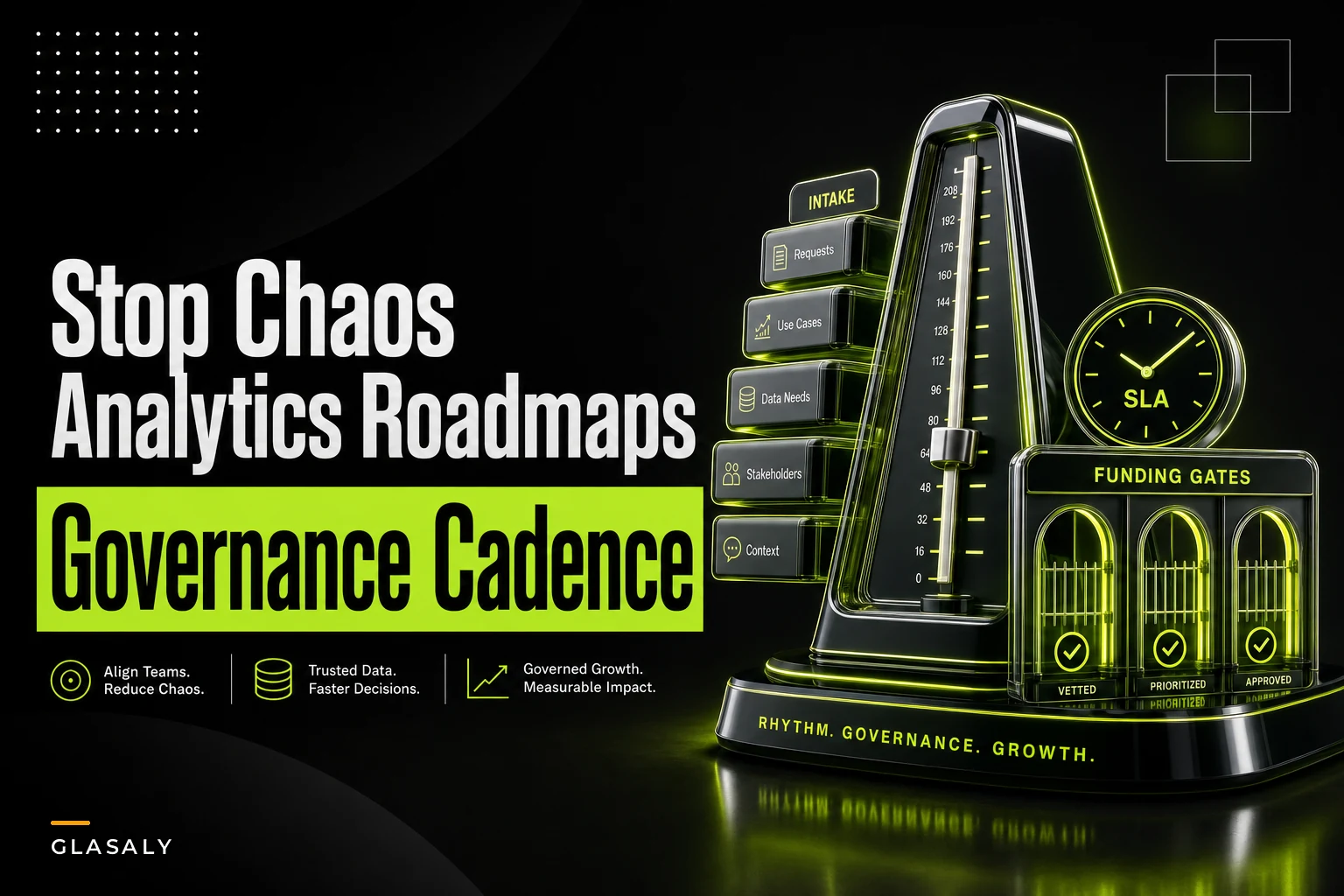

Most analytics teams don't have a roadmap problem. They have a cadence problem.
The roadmap exists. Someone built a slide deck in January with four strategic pillars and color-coded blocks. Then February hit — the VP of Sales wanted a churn dashboard, finance needed margin cuts by region, a pipeline broke, and three analysts spent six weeks on work that never appeared on that deck. By Q3 nobody's referencing the original plan because it stopped describing reality around week three.
A governance cadence fixes this — not by making a better plan, but by building the recurring machinery that decides what gets built, when, and with whose money. This is the part most analytics roadmap governance conversations skip entirely. They obsess over the strategy artifact and ignore the operating rhythm that actually turns strategy into sprints.
The three streams that fight for the same engineers
Before cadence, you need to be honest about what's really competing for your team's time. In almost every data team, work falls into three streams, and they rarely play nice:
-
Feature requests — new dashboards, new metrics, new cuts of existing data. Loud, visible, politically sponsored.
-
Experiments — hypothesis-driven work where the payoff is uncertain. A new attribution model, a churn predictor, a test of whether a leading indicator actually leads.
-
Platform debt — the plumbing. Pipeline refactors, schema cleanup, test coverage, the semantic layer nobody thanks you for maintaining.
The pattern that wrecks roadmaps: feature requests have sponsors, experiments have champions, and platform debt has nobody. Debt only has you. So every planning cycle, debt loses — quietly, until three pipelines fail in the same week and 40% of the quarter evaporates into firefighting.
A real governance cadence forces all three streams through the same intake and the same prioritization, so debt competes on equal footing instead of getting silently dropped every time someone important asks for a chart.
Intake: the front door needs a lock and a clock
If anyone can Slack an analyst and get work started, you don't have a roadmap. You have a queue sorted by who talks loudest.
Stop missing critical business insights.
Glasaly helps you create, share, and track interactive dashboards effortlessly.
- Real-time data visualization
- Collaborative report sharing
- Customizable analytics widgets
No credit card required
Intake governance means every request — feature, experiment, or debt — enters through one door with a standard format and a guaranteed response time. Not a guaranteed delivery time. A guaranteed response time. Those are different, and conflating them is why intake SLAs get a bad reputation.
We dug into the request-handling side in an earlier post on SLA-driven intake and prioritization, so I won't re-litigate the queue mechanics here. The piece that connects intake to the roadmap is the triage SLA — the promise that governs how fast a request gets classified and routed, not finished.
A workable set of intake SLAs looks like this:
| Request type | Triage SLA | Who triages | Default landing spot |
|---|---|---|---|
| Urgent (revenue/compliance at risk) | Same day | On-call analyst + lead | Current cycle, bump something |
| Standard feature request | 3 business days | Intake owner | Next quarter-planning review |
| Experiment proposal | 5 business days | Analytics lead + sponsor | Experiment backlog, scored |
| Platform debt | Logged immediately, reviewed weekly | Tech lead | Debt register, scored quarterly |
The mistake people make: they set an SLA on delivery and miss it constantly because delivery depends on priority, which hasn't been decided yet. Set your hard SLA on triage. That's the promise you can actually keep, and it's the one that stops people from going around the process.
A lightweight intake template
Set your hard SLA on triage, not delivery.
-
What decision will this change? (If the answer is vague, that's your first signal.)
-
Who is the sponsor, and what happens if we don't build it?
-
Rough value — revenue, cost, risk, or time saved. A range is fine.
-
Type — feature / experiment / debt.
-
Deadline driver — real external date, or just "soon"?
That first question does more filtering than anything else. "What decision will this change?" quietly kills about a third of requests, because a surprising number of dashboard asks can't name a single decision that would actually move. Those aren't requests — they're curiosity, and curiosity belongs in self-serve, not your build cycle.
Decision criteria: scoring that survives an executive in the room
A scoring model only matters if it holds up when a senior person disagrees with it. Most don't. Someone powerful wants their thing, the score says no, the score loses. After that happens twice, nobody trusts the model.
So the criteria have to be simple, defensible, and applied the same way to all three streams. What works in practice is a blunt three-factor score:
-
Impact (1–5)
how much does this move a strategic metric?
-
Confidence (1–5)
how sure are we it'll actually deliver that impact?
-
Effort (1–5, inverted)
smaller effort scores higher.
Multiply impact × confidence, divide by effort. Rank. The confidence factor is what keeps experiments honest — a flashy ML idea with impact 5 but confidence 2 lands below a boring feature with impact 3 and confidence 5, which is usually the right call.
The link between these scores and your actual strategy comes from your metric hierarchy. If you've already done the work of building a prioritized KPI hierarchy that connects strategy to measurement, the "impact" score stops being a gut guess — it maps to a specific node in that tree. Without a hierarchy, impact scoring collapses into opinion versus opinion.
One rule that protects the whole system: platform debt gets a confidence floor. Debt that reduces incident risk always scores confidence 4 minimum, because "this will prevent breakage" is one of the few things in analytics you can be genuinely confident about. Without that floor, debt loses every scoring contest and you're back to firefighting.
Funding gates: where good intentions go to die, or finally get built
Scoring tells you what's worth building. Funding gates decide what you're allowed to build this cycle given fixed capacity. These are separate decisions, and treating them as one is a classic mistake — teams score everything, approve everything high-scoring, then wonder why they committed to 180% of capacity.
A funding gate is just a checkpoint where someone with budget authority says yes, with conditions. The useful pattern is staged funding for anything uncertain:
-
Gate 1 — Discovery fund 2–3 days to validate the problem and rough the approach. Cheap to say yes.
-
Gate 2 — Build fund the full implementation, only if discovery confirmed the value. Most killed ideas should die here, and that's healthy.
-
Gate 3 — Productionize fund the ongoing maintenance, monitoring, and ownership. This is the gate everyone forgets, which is exactly how orphaned dashboards accumulate.
Staged gates matter most for experiments because that's where money quietly leaks. A team commits to a "quick" predictive model, it balloons into a six-week slog, and nobody wants to kill it at week four because they've already spent four weeks. A Gate 2 checkpoint gives you permission to stop without it feeling like failure — you funded discovery, discovery said no, you move on. That framing changes behavior.
For connecting these gates to actual dollars and ROI, there's more depth in the pragmatic analytics funding model with ROI scorecards. The cadence here is about when funding decisions happen; the scorecard is about how you justify them.
Visualizing the intake-to-gates workflow can make it easier to explain to stakeholders.
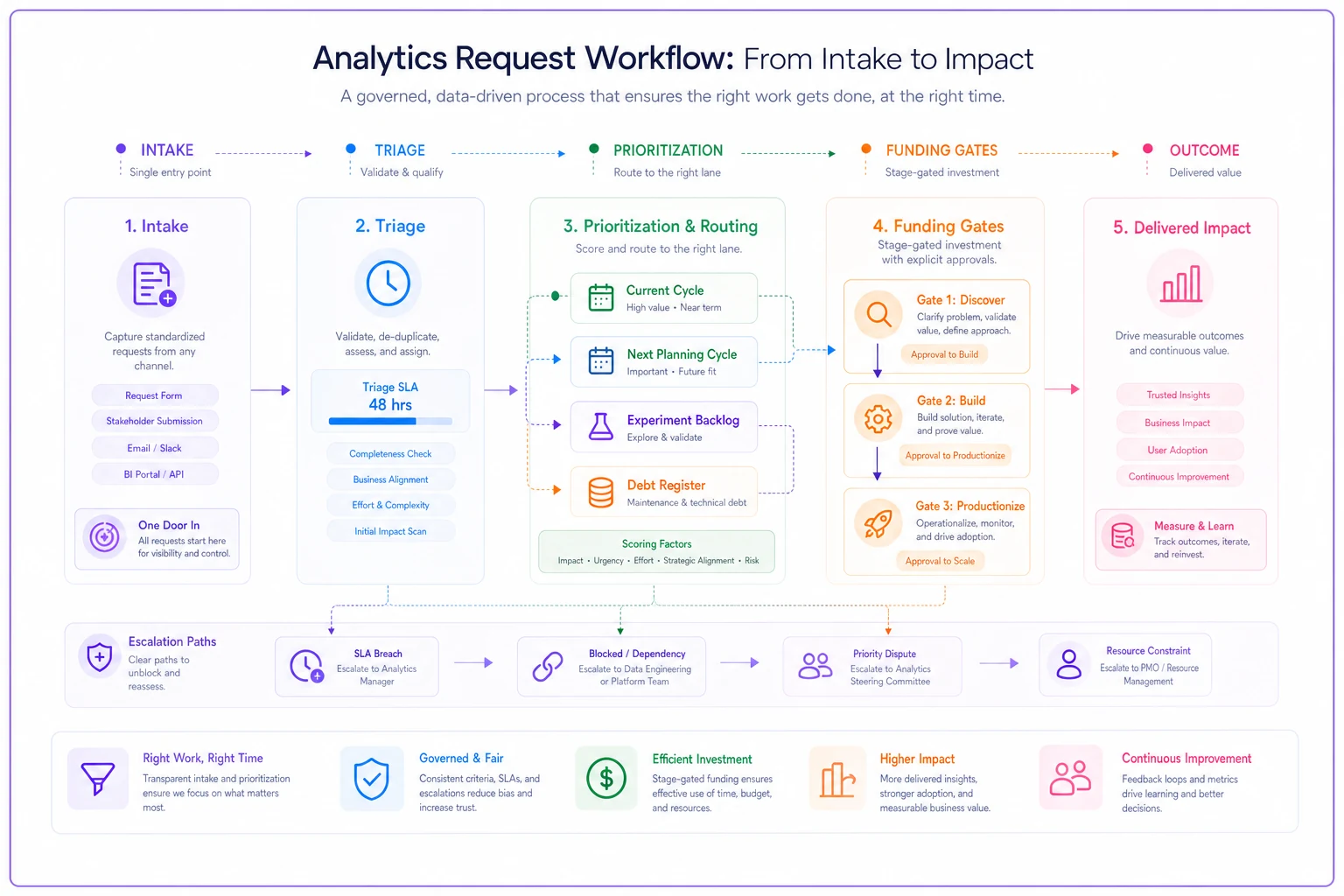
A simple diagram like this helps non-technical stakeholders see where decisions and money intersect.
Escalation rules: deciding who decides
Half of roadmap chaos isn't really about priorities. It's about ambiguity over who gets to override them. Someone escalates to the CEO, the CEO says "just do it," and your scored quarter gets reshuffled by one hallway conversation.
Escalation rules fix this by naming, in advance, who can bump the queue and what it costs. Not "nobody can interrupt us" — that's fantasy. Interruptions happen. The rule is that interruptions are visible and come with a stated tradeoff.
-
Analyst-level can resequence within the current cycle, no approval needed, as long as committed work still lands.
-
Lead-level can pull a new item into the current cycle, but must explicitly name what gets bumped out. No silent additions.
-
Sponsor/exec-level can force an urgent item in, but it's logged in the escalation register with the displaced work and the cost.
That third rule is the quiet hero. When executives have to name what they're displacing, roughly half the "drop everything" requests suddenly become "next cycle is fine." The emergency was never really about urgency — it was about the request feeling free. Make the cost visible and the urgency recalibrates fast.
Transparent artifacts: the stuff that makes it real
Governance that lives in someone's head isn't governance. The cadence needs artifacts that anyone can open and understand. Keep them few and keep them current — a dozen pristine documents nobody updates is worse than three slightly messy ones everyone trusts.
-
The intake register — every request, its score, status, and current landing spot. One source of truth for "where's my thing?"
-
The debt register — platform debt logged, scored, and visibly aging. Debt that's sat unaddressed for two quarters should get a visible flag.
-
The quarter plan — committed items, the three-stream split (e.g., 50% features / 20% experiments / 30% debt), and reserved capacity.
-
The escalation log — every interruption and what it displaced. This is your evidence when someone asks why the roadmap "slipped."
That three-stream split is worth defending openly. When leadership can see that only 30% went to platform health and incidents are rising, you have a data-backed argument for shifting the ratio. Without the visible split, "we need more time for plumbing" sounds like whining. With it, it's a chart.
When this cadence makes sense — and when it's overkill
This machinery has real overhead. Be honest about whether you actually need it.
It makes sense when you've got three or more analysts, multiple stakeholder groups competing for their time, and a recurring sense that the team is busy but the strategic stuff never ships. That gap — busy but not strategic — is the clearest signal you have an intake and prioritization problem, not a talent problem.
It's overkill when you're a one- or two-person data team with a single primary stakeholder. At that size, a shared backlog and a weekly check-in beats formal gates and registers. Installing heavy governance on a tiny team just adds ceremony to work that could've been a conversation.
Who should not roll this out all at once: teams in the middle of an active crisis. If pipelines are on fire, stabilize first, then build cadence. Introducing funding gates during a firefight just adds process friction to people who are already drowning. Start with intake triage SLAs, get that habit solid, then layer in scoring and gates over the next couple of quarters.
A real scenario: the ops analytics team that was always behind
A mid-sized e-commerce operation — four analysts supporting ops, merchandising, and finance — had the classic symptom. Everyone felt the team was slow, the team felt slammed, and nobody could point to what strategic work had actually shipped that year.
When they mapped six months of completed work against their stated roadmap, the picture was stark: roughly 70% of delivered hours went to unplanned ad-hoc requests, around 25% to feature work that happened to get requested, and essentially nothing to the platform debt that was causing the pipeline failures eating their weeks.
They changed three things. One intake door with a 3-day triage SLA. A simple impact × confidence ÷ effort score applied to all requests, including debt. And a quarter plan with a committed 30% debt allocation that leadership actually signed off on.
Two quarters later the numbers had shifted. Unplanned ad-hoc work dropped to somewhere in the 35–40% range, and because they'd finally funded the debt, pipeline incidents fell enough that firefighting time roughly halved. Nobody worked more hours. They just stopped letting the loudest request win by default and stopped letting debt lose by default. The team that was "always behind" shipped two of its four strategic initiatives that year — up from zero.
The quiet truth about roadmap governance
The hard part of analytics roadmap governance isn't designing the scoring model or writing the intake template. It's holding the line when a senior person wants to skip the process — and then doing it again the following week.
The cadence works precisely because it's boring and repetitive. Same intake door, same triage clock, same scoring, same gates, same visible artifacts, every single cycle. The first month feels like bureaucracy. By the third quarter it feels like relief, because for the first time the plan you made in January still describes what you're actually building in September.
That's the whole point. Not a better roadmap. A roadmap that survives contact with reality.
Ready to elevate your business intelligence?
Join 2,500+ businesses leveraging Glasaly to drive smarter decisions, improve team alignment, and boost operational performance.