

Most analytics teams experience audits the same way: someone from legal, security, or a customer's procurement team sends an email with "urgent" in the subject line, and then three weeks of everyone's calendar disappears while people dig through Slack threads trying to remember who approved access to the customer PII table back in March.
The problem isn't that teams don't care about compliance. It's that compliance lives in people's heads, scattered across documents, and in the tribal knowledge of whoever happened to be around when the decisions were made two quarters ago. When an auditor asks "show me who can see this data and why," the honest answer is usually "give us a few days."
What separates teams that dread audits from teams that barely notice them is whether their compliance rules are runnable. Not written down somewhere. Not "documented" in a Confluence page nobody has touched since onboarding. Runnable — meaning the access rule, the consent flag, the contract clause, and the incident owner are all attached to the actual data artifact, and you can query the current state instead of reconstructing history.
That's what an analytics compliance framework actually looks like when it works. It's not a policy binder. It's a mapping between how sensitive a piece of data is and the concrete, executable controls that protect it. Here's how to build that mapping so audits become something you run, not something you survive.
The core idea: risk tiers mapped to runnable artifacts
The thing that breaks in almost every growing analytics org is that sensitivity and controls drift apart. You start with a clean idea — "customer data is sensitive, so it's locked down." Then someone builds a marketing dashboard that joins customer emails into an aggregate, someone else copies a table into a sandbox for a one-off analysis, and six months later you have forty datasets that contain sensitive fields but only four of them have any real controls.
The fix is to stop thinking about controls as things you apply case-by-case and start thinking in tiers. Every dataset, model, and dashboard gets a sensitivity tier. Every tier maps to a fixed set of runnable artifacts. No exceptions, no "we'll handle it later."
| Risk Tier | Example Data | Access Rule | Consent Metadata | Contract Clause Required | Audit Frequency | Incident Owner |
|---|---|---|---|---|---|---|
| T0 – Public | Aggregated KPIs, published metrics | Open read within org | None | None | Annual spot-check | Data platform lead |
| T1 – Internal | Ops metrics, non-PII operational data | Role-based, team scoped | None | Standard DPA | Semi-annual | Team data owner |
| T2 – Confidential | Revenue detail, unaggregated behavioral data | Least-privilege, approval logged | Purpose tag required | DPA + purpose limitation | Quarterly | Domain owner + security |
| T3 – Restricted | PII, health, financial identifiers | Named-user only, time-boxed grants | Full consent lineage | DPA + processing addendum + audit rights | Continuous logging, quarterly review | Named DPO + security lead |
The point of the table isn't the specific tiers — yours might differ. The point is that once a dataset gets tagged T2, everything else is determined. You don't debate the access rule. You don't wonder whether it needs a purpose tag. The tier decides.
Teams who skip this step end up making the same fifteen decisions over and over, slightly differently each time, which is exactly what an auditor loves to find.
Why this falls apart across most businesses
The failure mode isn't dramatic. It's slow. A team starts with good intentions and a reasonable access model — probably something close to the least-privilege setup that most mature teams eventually land on. If you haven't formalized that layer yet, the analytics access operating model with least-privilege rules and audit checklists is the foundation this whole framework sits on top of. Compliance tiers are useless if the underlying access system is a free-for-all.
Stop missing critical business insights.
Glasaly helps you create, share, and track interactive dashboards effortlessly.
- Real-time data visualization
- Collaborative report sharing
- Customizable analytics widgets
No credit card required
But even with solid access controls, three things erode the system as you scale.
Copies multiply faster than governance. In practice, this usually happens when an analyst needs a quick answer, exports a T3 table into a personal schema, and forgets to delete it. The original table is locked down. The copy has none of the tier's controls. Multiply that across a team of eight analysts over a year and you have dozens of untracked sensitive copies floating around.
Consent context gets stripped in transformations. A raw table might have clear consent metadata — this user opted in to marketing analytics on this date. Then it goes through three joins and an aggregation, and the resulting table has no idea what consent basis it inherited. The lineage exists in the SQL, but not in any queryable form.
Ownership dissolves during reorgs. The person who owned the T2 dataset left, their team got merged, and now when something goes wrong, nobody's name is attached. The dataset is still there, still sensitive, still exposed — just orphaned.
None of these are exotic edge cases. They're the default trajectory of any analytics environment that grows without the tier mapping enforced at the artifact level.
Making the gates copyable
A compliance framework that requires humans to remember rules will fail. A framework where the rules are gates in the pipeline will hold.
A "gate" is just a check that blocks something from happening unless the tier's requirements are met. The trick is making them copyable — templates a team can drop into their existing deployment flow without a six-month platform project.
A basic tier-enforcement gate for a data deployment looks like this in pseudocode: def tiergate(dataset): tier = dataset.metadata.get("risktier") if tier is None: block("No risk tier assigned. Assign before deploy.") if tier in ["T2", "T3"]: require(dataset.metadata.get("owner"), "Owner required for T2+") require(dataset.metadata.get("purposetag"), "Purpose tag required") require(accessisleastprivilege(dataset), "Access too broad") if tier == "T3": require(dataset.metadata.get("consentlineage"), "Consent lineage missing") require(grantsaretimeboxed(dataset), "T3 grants must expire") loggateresult(dataset, tier)
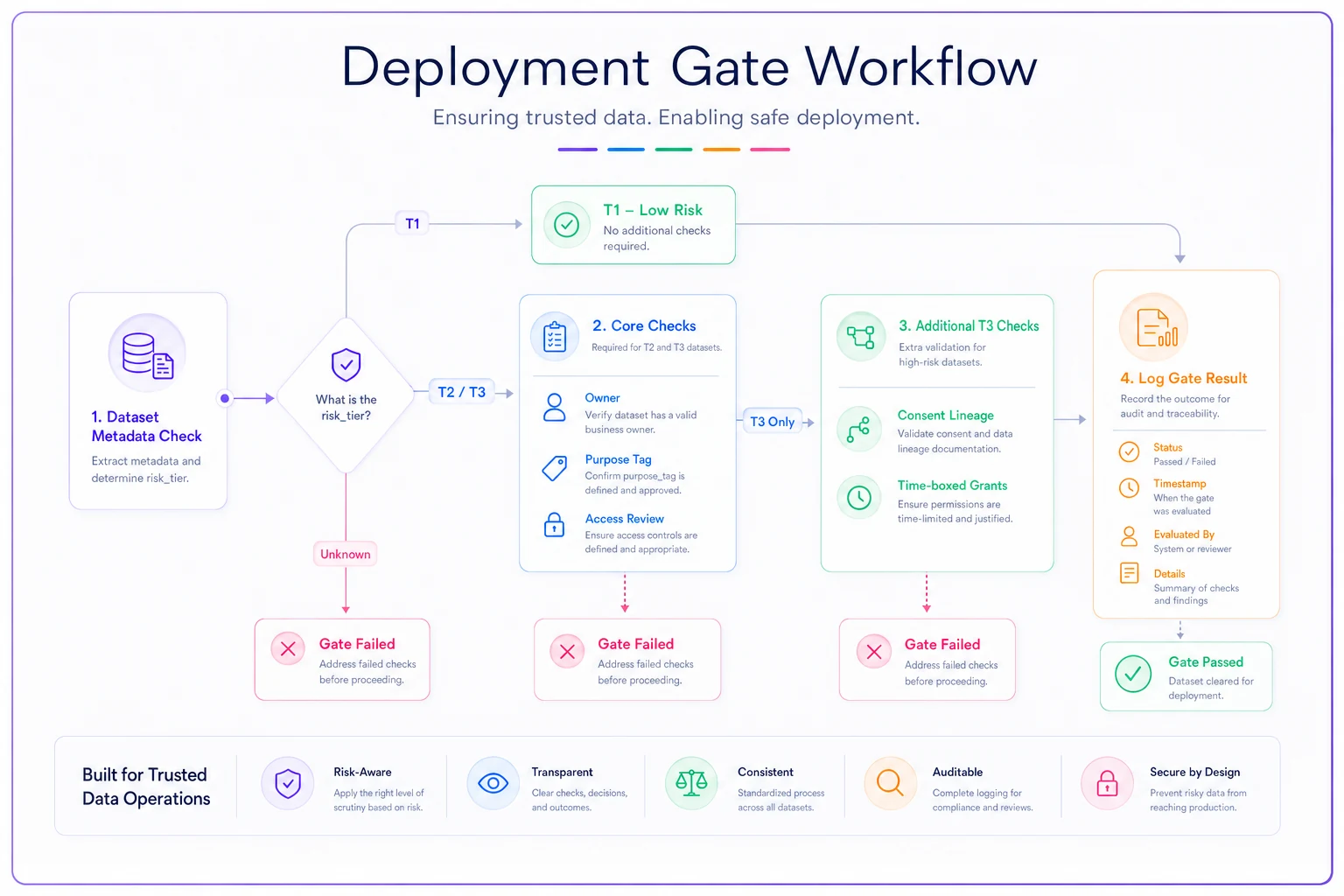
The value isn't the code itself — it's that the rule now runs every deploy instead of living in someone's memory. When the auditor asks "how do you ensure T3 data always has consent lineage," the answer is "the gate blocks deployment if it doesn't, and here's the log of every check."
Make gate templates small and language-specific so teams can drop them into CI without major platform work.
A second gate worth copying is the copy detection sweep — a scheduled job that scans for tables containing sensitive column patterns (emails, SSNs, card numbers) and flags any that don't carry a tier tag. This catches the untracked-copy problem before an auditor does.
Consent metadata that survives transformations
The consent problem deserves its own section because it's where most teams are quietly non-compliant without realizing it.
The rule that works: consent metadata must propagate through lineage, not just live at the source. When a T3 table feeds into a derived table, the derived table inherits — at minimum — the most restrictive consent basis of its parents. If you join a marketing-consent table with a table that has no consent basis, the result gets treated as the stricter tier until someone explicitly reviews it.
-
Consent basis — what legal ground allows this processing (consent, contract, legitimate interest)
-
Purpose limitation — what this data is allowed to be used for
-
Collection date range — when consent was captured
-
Retention deadline — when this must be deleted or re-consented
-
Upstream sources — the parent datasets this inherited from
The mistake people make is treating consent as a one-time checkbox at ingestion. Consent has a shelf life. A user who opted in eighteen months ago under old terms may not count under current requirements, and if your retention deadline field is empty, you have no way to run a "what needs to be purged this quarter" query. That query should be a scheduled report, not a scramble.
This ties directly into how you handle data that arrives late or gets corrected after the fact. If your consent and correction workflows aren't coordinated, you end up re-processing data whose consent basis has already expired. The patterns in managing late-arriving data and backfills with acceptance windows and correction workflows matter here — a backfill that pulls in old records needs to re-check consent validity, not just data quality.
Contract language analysts can actually operationalize
Contracts are where compliance usually goes to die. The clauses get negotiated by legal, filed away, and never translated into anything the data team can act on. A processing addendum that says "vendor will maintain appropriate technical safeguards" is legally fine and operationally useless.
The clauses worth pushing for are the ones that map to a runnable check. When you're setting terms with a vendor — or setting the terms your own team commits to internally — you want language that a data engineer can turn into a monitor. This overlaps heavily with the freshness and acceptance-test thinking in what to demand from vendors around metrics contract clauses and acceptance tests, extended to compliance obligations.
Copyable clause language that operationalizes cleanly:
Purpose limitation clause: > "Data classified at tier T2 or above shall be processed solely for the purposes enumerated in the attached purpose registry. Any new processing purpose requires written approval and a corresponding purpose-tag update before processing begins."
This is enforceable because "purpose registry" and "purpose tag" are things you actually maintain — the gate above checks for them.
Audit rights clause: > "Processor shall maintain queryable access logs for all tier T3 datasets for a minimum of 24 months, and shall provide, within 5 business days of request, a report identifying all principals with access, the grant basis, and grant expiration."
Notice the specificity. "Within 5 business days" and "queryable access logs" and "grant expiration" are all things your logging setup can produce. A vague clause about "reasonable audit cooperation" gives you nothing to build against.
Deletion and retention clause: > "Upon expiration of the retention deadline recorded in dataset metadata, or upon consent withdrawal, Processor shall delete affected records within 30 days and provide confirmation logs."
The mistake most teams make is negotiating strong-sounding contract language they have no technical ability to fulfill. If the clause says you'll produce access reports in five days but it actually takes your team three weeks of manual work, you've signed up for a compliance failure. Only commit to clauses your gates and logs can actually back.
The audit checklist that makes review boring
Boring is the goal. A good audit should be boring because there's nothing to discover.
Here's a checklist a data owner should be able to run against any tier T2+ dataset in under an hour:
-
[ ] Dataset has a current risk tier tag matching its actual contents
-
[ ] Named owner is a current employee (not orphaned by a reorg)
-
[ ] Access list matches least-privilege — every grant traces to a documented need
-
[ ] All T3 grants have an expiration date, and none are expired-but-active
-
[ ] Purpose tag exists and matches actual usage in downstream dashboards
-
[ ] Consent lineage is populated and inherited correctly from parents
-
[ ] Retention deadline is set and not past due
-
[ ] Access logs are queryable for the required retention window
-
[ ] No untracked copies of this data exist in sandbox or personal schemas
-
[ ] Incident owner is assigned and reachable
Every item on this list is verifiable by query rather than by opinion. "Access list matches least-privilege" isn't a judgment call if you have a documented need attached to each grant — you're just diffing two lists. That's what makes this checklist more useful than most.
Run this quarterly on a rotating sample of datasets and you'll catch drift while it's still small. What tends to happen otherwise is that teams run one massive audit right before a customer review, find forty problems at once, and fix them in a panic that itself introduces new gaps.
Incident responsibilities: naming names before the incident
The last piece is the one everyone skips until it's too late. When a data exposure happens — a misconfigured dashboard, a leaked export, a vendor breach — the first fifteen minutes matter a lot, and those fifteen minutes get wasted if nobody knows who's supposed to act.
Every tier needs a named incident owner, and "named" means an actual person, not a team. Teams don't act; people do. The incident owner for a T3 dataset should be able to answer, without looking anything up, in roughly this order:
-
Contain — who can revoke access and pull the dashboard offline right now
-
Assess — who determines what data and how many records were exposed
-
Notify — who decides whether this triggers a customer or regulatory notification, and on what clock
-
Remediate — who fixes the root cause so it doesn't recur
-
Document — who writes the postmortem and updates the gate that should have caught it
Every incident should end with a gate change. If a T3 table got exposed because someone made a broad copy, the copy-detection sweep gets tuned. If consent lineage was missing, the deployment gate gets stricter. An incident that doesn't harden the system is an incident you'll repeat.
A real scenario: a mid-sized SaaS analytics team
A B2B software company with roughly 40 people had an analytics team of five supporting product, revenue, and customer success. They stored behavioral data and account-level PII, and they'd started losing enterprise deals because prospects' security teams kept asking questions they couldn't answer quickly.
Before the framework: their last customer security review took about three weeks of combined effort across the data team and their one security engineer. They found around 20 untracked copies of sensitive tables sitting in analyst sandboxes. Nobody could produce a clean access report — grants had accumulated for two years with no expirations, and roughly a third of the people with access to the revenue tables no longer needed it. Two datasets had owners who had left the company months earlier.
They spent about six weeks implementing the tier mapping — tagging datasets, adding the deployment gate, building the copy-detection sweep, and attaching consent metadata to their T3 tables. Not glamorous work. Mostly tedious cleanup.
The next security review took a little under three days. The access report was a query. The untracked copies had dropped to near zero because the sweep flagged them weekly. When the prospect's team asked "show me who can see account data and why," they exported the access list with documented needs attached and moved on. They closed the deal.
The number that stuck with the team wasn't the deal size. It was that quarterly audits went from a dreaded multi-week event to something a data owner knocked out in an afternoon.
When this framework makes sense — and when it's overkill
When it makes sense: You handle customer PII, financial data, or health information. You sell to enterprise customers who run security reviews. You're in a regulated space, or you're approaching a size where reorgs regularly orphan ownership. If you're past roughly 15–20 people with a real analytics function, the tier mapping pays for itself the first time an audit shows up.
When it's overkill: A three-person startup working entirely with public or aggregate data doesn't need T3 controls on anything. Building full consent lineage before you have consent-sensitive data is premature. Start with the tier concept — even two tiers is fine — and add machinery only as sensitive data enters your environment.
Who should not do this yet: If your underlying access model is still ad hoc and nobody owns datasets at all, fix the access foundation first. Layering compliance tiers on top of a broken access system just gives you the illusion of control. Get least-privilege and clear ownership working, then map tiers onto it.
The whole point of a compliance framework is to move the work earlier — into gates and metadata and named owners — so that audits become a read operation instead of an investigation. Sensitivity maps to tiers. Tiers map to runnable artifacts. The gate enforces it at deploy. The sweep catches drift. The checklist verifies by query. The named owner acts when something breaks, and the postmortem hardens the gate.
None of the individual pieces are complicated. What's hard is the discipline to attach controls to artifacts instead of storing them in people's heads. Teams that make that shift stop experiencing audits as crises. The auditor asks a question, they run a query, and everyone gets back to work.
Ready to elevate your business intelligence?
Join 2,500+ businesses leveraging Glasaly to drive smarter decisions, improve team alignment, and boost operational performance.