


Most vendor data contracts are written by the vendor's legal team, and it shows. They cover uptime, liability, and payment terms in painful detail — then wave their hands at the part that actually matters to your analytics team: what the data itself has to look like. Schema, freshness, completeness, how corrections get communicated. All the stuff that breaks your dashboards on a Tuesday morning while you're staring at a KPI that dropped 30% overnight for no obvious reason.
If you're pulling in third-party data — a payments processor, an enrichment provider, a marketing attribution feed, a logistics API — the contract you sign is the only leverage you'll ever have over that data's quality. Once the ink is dry, you're stuck consuming whatever they send you, on whatever schedule they feel like, with whatever silent schema changes their engineers push on a Friday afternoon.
This post covers the specific clauses, acceptance tests, and remediation SLAs you should demand before signing. Not the boilerplate. The parts that keep your metrics honest.
The failure mode almost nobody negotiates against
A scenario that plays out more than it should: a mid-sized ecommerce team integrates a third-party product-enrichment feed — categories, brand tags, dimensions, that kind of thing. The vendor demo looked great. The sample file was clean. Six weeks after go-live, someone notices that "category" started arriving as null for about 12% of new SKUs.
Nobody at the vendor said anything. No alert. The field just quietly degraded because the vendor changed an upstream source and never backfilled the mapping. The analytics team found out because a merchandising dashboard showed an "Uncategorized" bucket ballooning — and by then it had been happening for nine days.
The contract? It guaranteed 99.9% API uptime. The API was up the entire time. Returned 200 OK on every request. It was just returning garbage in a field that mattered.
That's the gap. Uptime is not correctness. Availability is not freshness. A successful response is not a valid one. Vendor contracts obsess over the first item in each pair and ignore the second — and the second is where your metrics actually live.
What a real metrics contract clause looks like
A useful vendor data contract treats the data as the deliverable, not the endpoint. That means writing clauses about the shape and content of what arrives, with numbers attached and consequences behind them.
Stop missing critical business insights.
Glasaly helps you create, share, and track interactive dashboards effortlessly.
- Real-time data visualization
- Collaborative report sharing
- Customizable analytics widgets
No credit card required
Below is the difference between what vendors typically offer and what you should be pushing for.
| Dimension | Typical vendor clause | What you should demand |
|---|---|---|
| Availability | "99.9% API uptime" | Uptime plus a freshness SLA: data reflecting events up to time T must be available by T + X |
| Schema | Silence, or "we may update the schema" | No breaking schema change without 30 days' written notice and a versioned endpoint during transition |
| Completeness | None | Named required fields must be non-null on ≥ Y% of rows, measured per batch |
| Accuracy | None | Defined parity thresholds against a reference or prior period, with tolerance bands |
| Corrections | "We may restate data" | Restatements delivered through a documented correction channel with change logs |
| Remediation | Service credits for downtime only | Tiered remediation SLAs tied to severity of the data defect, not just outages |
The right-hand column is what turns a contract from a liability shield into an operational tool. Most vendors will agree to a surprising amount of it if you ask before signing — because at that point they want the deal. After signing, you have zero leverage.
Sample clause language you can adapt
Freshness. "Vendor shall deliver data such that 95% of records reflecting an event occurring at time T are available to Consumer no later than T + 4 hours, measured on a rolling 7-day basis. Freshness below this threshold for more than 6 consecutive hours constitutes a Severity 2 incident."
Completeness. "For the fields listed in Appendix B (Required Fields), Vendor warrants that no more than 2% of records in any daily batch shall contain null or empty values. Breach of this threshold on two consecutive days triggers the remediation process in Section 9."
Schema stability. "Vendor shall provide no fewer than 30 calendar days' written notice prior to any change that removes a field, renames a field, changes a field's data type, or alters the cardinality of an enumerated field. During the transition period, Vendor shall maintain the prior schema version at a stable, separately addressable endpoint."
That last clause on enumerated fields matters more than people expect. A vendor quietly adding a new value to a status enum — say a new partially_refunded state — won't throw an error anywhere. It'll just silently reroute rows in your aggregations and make a revenue metric drift by a percent or two, which is exactly the kind of thing nobody catches for weeks.
Acceptance tests: the gate before data becomes "trusted"
A contract clause is a promise. An acceptance test is how you verify the promise on every batch, automatically, without hoping someone eyeballs it. Think of acceptance tests as the entry checkpoint every incoming vendor feed has to pass before it's allowed to touch a production model or dashboard.
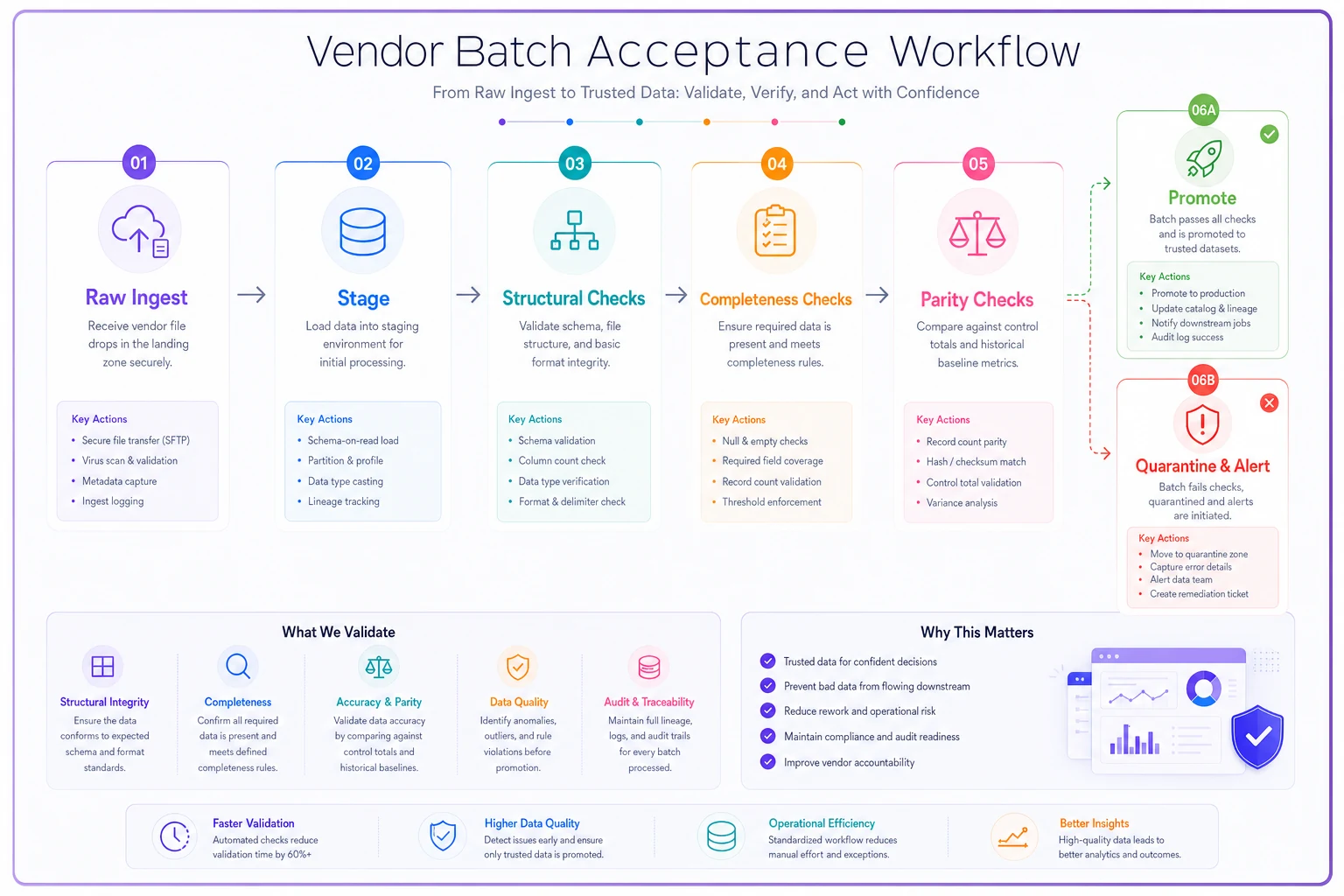
A workflow that holds up in practice:
-
Land the raw batch in a staging area. Never let vendor data write directly into anything a dashboard reads. Staging first, always.
-
Run structural checks. Does the schema match the contracted version? Are all required fields present? Did any column change type? A single failure here quarantines the batch.
-
Run completeness checks. For each required field, is the null rate under the contracted threshold? Is the row count within an expected band relative to the trailing 7-day average? A batch that's 40% smaller than usual is a red flag even if every row is technically valid.
-
Run parity checks. Compare key aggregates against the prior period and, where possible, against an independent reference. More on this below.
-
Promote or quarantine. Passing batches get promoted to the trusted layer. Failing ones get held, and an alert fires to both your team and the vendor's support channel with the specific check that failed.
Vendor Batch Acceptance Workflow — from raw ingest through staging, structural checks, completeness checks, parity checks, to either promotion or quarantine with alert
The mistake teams make is running these checks after the data has already flowed into dashboards — as monitoring rather than as a gate. Monitoring tells you your metrics were wrong yesterday. A gate stops them from being wrong today. The difference in blast radius is significant.
This same discipline applies to your own internal feeds, not just vendor ones — it overlaps heavily with treating datasets as products with contracts and discoverability, where acceptance criteria are agreed upfront and enforced consistently.
Parity checks: how you catch the silent stuff
Structural and completeness checks catch obvious breakage. Parity checks catch the sneaky kind — where the data is well-formed, complete, and wrong.
-
Row-count parity against a system you control. If your payment processor sends a daily settlement file, the number of transactions should reconcile against your own checkout records within a small tolerance. A widening gap means one side is dropping records.
-
Aggregate parity against the prior period. Total revenue by day-of-week tends to be stable within a band. If the vendor's reported total swings outside historical variance, flag it.
-
Distribution parity. The proportion of records across an enumerated field — payment method, region, category — shouldn't lurch overnight. A sudden shift usually means an upstream mapping change, not a real-world one.
A concrete tolerance example: for a payments feed, you might set a rule that the vendor's daily transaction count must be within ±1.5% of your internal order count. Most days it lands within a few tenths of a percent. The day it doesn't is the day you want to know before finance closes the books.
Parity checks are also the only real defense against a vendor restatement silently rewriting history. If they backfill or correct three weeks of data, your day-over-day parity check on those historical partitions will light up immediately — you'll know a correction landed even if the vendor's change log was vague.
Remediation SLAs that mean something
This is where most contracts collapse into uselessness. The "remediation" section usually offers service credits — a small percentage off next month's bill if uptime dips. Fine for outages, completely irrelevant to data defects. A 5% credit doesn't fix a metric that misled your leadership team into a bad inventory decision.
-
Severity 1 — Corrupt or missing critical data. A required field is broadly null, or a batch is missing entirely. Vendor acknowledges within 1 hour, provides root cause within 4 hours, and delivers a corrected batch within 24 hours.
-
Severity 2 — Freshness or completeness breach. Data is late or partially incomplete beyond contracted thresholds. Acknowledgment within 4 hours, resolution within 2 business days.
-
Severity 3 — Minor anomalies. Distribution drift, non-critical field degradation. Acknowledgment within 1 business day, resolution in the next scheduled release.
Attach escalating consequences to repeated breaches. A single Severity 2 is a hiccup. Three in a rolling 30-day window should trigger a mandatory review call and fee relief that actually stings — enough that the vendor's account manager feels it internally. That's the mechanism that changes vendor behavior. Politeness doesn't.
One clause worth including specifically: a notification obligation. The vendor must proactively tell you when they detect a data defect on their end, within a defined window — even one you haven't caught yet. This flips the burden. Without it, vendors have every incentive to stay quiet and hope you don't notice. With it, silence itself becomes a contract breach.
A short real scenario
A regional logistics company was ingesting a third-party address-validation and geocoding feed to power delivery-zone analytics and route-cost reporting — around 50,000 validation calls a day.
The problem: the vendor changed a confidence-score scale from 0–100 to 0–1 in a minor release, with no notice. Every downstream rule filtering on "confidence > 70" suddenly passed nothing, because every score was now between 0 and 1. Delivery-zone assignments went haywire for about four days before anyone connected the dots, and the ops team spent close to two weeks reconciling misrouted cost allocations.
At renewal, they renegotiated and added three things: a schema-change notice clause with a versioned endpoint, a distribution parity check on the confidence field as an acceptance gate, and a Severity 1 remediation SLA for any change that altered a field's value range. The technical work to build the acceptance gate took a couple of days. The next time the vendor shifted a field — about five months later — the batch was quarantined automatically, the alert fired the same morning, and nothing reached production.
The first incident cost somewhere in the low five figures once you counted reconciliation labor. The second cost a few hours. That's the whole argument for this work in one story.
When to push hard, and when not to bother
Not every vendor feed deserves this level of scrutiny. Layering a full acceptance-gate pipeline and a tiered remediation SLA onto a low-stakes feed is over-engineering, and it'll annoy a small vendor into walking away from the deal.
Push hard when:
-
The feed drives a metric that leadership or finance actually acts on
-
The data flows into automated decisions (routing, pricing, inventory)
-
The vendor is large enough to have engineers who push changes independently of your account
-
Restatements or corrections are common in that data category (payments, attribution, market data)
Don't over-invest when:
-
The feed is enrichment-only and a defect degrades quality gracefully rather than breaking anything
-
You're piloting the vendor and haven't decided to depend on them
-
The vendor is a small shop where a heavyweight contract creates more overhead than protection
For that last case, the pragmatic move is to keep the acceptance tests on your side regardless — the vendor doesn't have to agree to an SLA for you to quarantine a bad batch — and skip the elaborate contractual language until the relationship proves it's worth formalizing.
Who should own this
The mistake here is treating vendor data quality as either purely legal or purely engineering. Legal writes the clause language, engineering builds the acceptance tests — but the person who has to define the thresholds is the analyst or ops lead who actually knows what "normal" looks like for that data. They're the only one who knows that a 40% batch-size drop is alarming, or that the payment-method distribution is stable within two points.
The cleanest setup treats vendor feeds as part of your broader internal data operating model, with defined owners, thresholds, and escalation paths — the same way you'd run analytics as an internal service with SLAs and clear roles. A vendor SLA that nobody owns internally is just a document. Someone has to watch the gate, triage the quarantines, and be the one who calls the vendor when a Severity 2 fires. Assign that person before you sign, not after the first incident.
Bringing it together
The core shift is straightforward to state and harder to actually do: stop treating third-party data as something you passively receive, and start treating it as a deliverable with acceptance criteria you enforce on every batch.
The contract gives you the right to demand quality. The acceptance tests and parity checks give you the ability to detect problems the moment they arrive. The remediation SLA gives the vendor a reason to care. Get those three working together and the "why did this metric drop 30% overnight" fire drills mostly disappear — not because vendors stopped shipping bad data, but because bad data stopped reaching your dashboards.
Negotiate for it while you still have leverage, build the gate on your side regardless of what the vendor agrees to, and make sure a real person owns the thresholds. That's the difference between a vendor relationship that quietly corrodes your metrics and one you can actually trust.
The core shift is straightforward to state and harder to actually do: stop treating third-party data as something you passively receive, and start treating it as a deliverable with acceptance criteria you enforce on every batch.
Negotiate for it while you still have leverage, build the gate on your side regardless of what the vendor agrees to, and make sure a real person owns the thresholds. That's the difference between a vendor relationship that quietly corrodes your metrics and one you can actually trust.
Ready to elevate your business intelligence?
Join 2,500+ businesses leveraging Glasaly to drive smarter decisions, improve team alignment, and boost operational performance.