



The worst dataset failures happen quietly. A finance analyst builds their quarterly forecast on what they think is the authoritative sales dataset. Meanwhile, marketing pulls from a different version with adjusted attribution logic. Operations uses yet another variant with different date definitions. Three months later, board reporting shows conflicting numbers, everyone's pointing fingers, and you spend two weeks untangling which dataset was supposed to be the "real" one.
This mess happens because most companies treat datasets like files on a shared drive instead of products with actual users, contracts, and lifecycles. Treating internal datasets exactly like you'd treat any product you ship to customers is what actually works.
The hidden cost of dataset chaos
Most businesses don't realize how much unmanaged datasets actually cost them until something breaks spectacularly. Take a mid-size retail operation I worked with last year. They had roughly 180 datasets floating around - everything from daily inventory snapshots to customer behavior aggregations. Nobody owned them. Nobody knew which ones mattered. The data team spent about 40% of their time just figuring out which datasets to use for basic questions.
The breaking point came during peak season planning. The merchandising team had been using an old product performance dataset that nobody realized stopped updating properly six months earlier. They planned inventory buys based on stale data, ended up with $400k in excess seasonal inventory, and had to run heavy discounts that crushed their Q4 margins.
This pattern shows up everywhere - sales comp calculations using datasets with different commission logic, customer success tracking churn with datasets that define "active" differently, finance forecasting from datasets that handle refunds inconsistently, marketing attributing conversions to campaigns using outdated mapping tables.
What makes this particularly painful is how these issues compound. One team builds new datasets on top of problematic ones. Another team creates workarounds that become permanent fixtures. Before long, you've got a tangled mess where changing anything risks breaking everything.
Why traditional documentation fails
Documentation fails because it treats datasets as static resources instead of evolving products. Datasets change constantly - new fields get added, calculation logic shifts, source systems evolve. Traditional documentation can't keep up with this pace of change. More importantly, it doesn't create any accountability or ownership structure.
Stop missing critical business insights.
Glasaly helps you create, share, and track interactive dashboards effortlessly.
- Real-time data visualization
- Collaborative report sharing
- Customizable analytics widgets
No credit card required
The other common approach is building a data catalog. These tools promise to solve everything through automated discovery and lineage tracking. But without clear ownership and lifecycle management, data catalogs just become expensive graveyards where datasets go to be forgotten. You end up with 500 datasets indexed, but nobody knows which 50 actually matter for running the business.
The dataset-as-product mindset shift
Treating datasets as products means applying the same rigor you'd use for any customer-facing product. Each dataset needs an owner, users with clear expectations, and defined lifecycle stages. This isn't about adding bureaucracy - it's about preventing the kind of operational disasters that happen when critical business decisions rely on mystery data.
A product manager wouldn't ship a feature without understanding who uses it and what they expect. Yet companies routinely create datasets without knowing who depends on them or what happens if they break. This disconnect creates massive operational risk that compounds over time.
When you treat datasets as products, several things change - someone is accountable when things break, users know what they can rely on, changes happen through a predictable process, and retirement doesn't leave teams scrambling.
The retail company I mentioned earlier implemented this approach after their inventory disaster. Within six months, they'd reduced data-related incidents by roughly 70% and cut the time spent investigating data discrepancies from hours per day to maybe an hour per week.
The dataset contract schema
A dataset contract creates explicit agreements between data producers and consumers. Unlike traditional documentation that quickly becomes stale, contracts define the unchangeable guarantees that users can depend on.
Here's a practical schema you can copy and adapt:
| Field | Description | Example |
|---|---|---|
| Name | Unique dataset identifier | dailysalessummary |
| Owner | Team or person responsible | revenueopsteam |
| Purpose | Primary business use cases | Daily revenue tracking, commission calculations |
| Update Frequency | How often data refreshes | Daily at 6 AM ET |
| SLA | Uptime guarantee | 99.5% monthly |
| Schema | Field definitions and types | saledate (date), revenueusd (decimal) |
| Dependencies | Upstream and downstream connections | Depends on: raw.transactions |
| Change Policy | Notice periods for modifications | 30 days for breaking changes |
This contract becomes the single source of truth. When the finance team needs sales data for their models, they know exactly what guarantees this dataset provides. When engineering needs to update the schema, they understand the downstream impact and required notice periods.
Onboarding checklist for dataset owners
Taking ownership of datasets requires more than just assigning names to a spreadsheet. Owners need clear responsibilities and the tools to execute them.
-
Week 1
Understanding Current State
- Inventory all datasets you're responsible for - Document current users (check query logs for the last 90 days) - Identify critical downstream dependencies - Review existing documentation and quality issues - Set up monitoring for your datasets -
Week 2
Establishing Contracts
- Create dataset contracts using the schema template - Validate guarantees with current technical capabilities - Review contracts with primary users - Document any gaps between expectations and reality - Publish contracts to shared repository -
Week 3
Building Relationships
- Schedule monthly check-ins with top 3 users - Create a simple feedback channel (Slack channel or email alias) - Document known issues and improvement roadmap - Establish escalation path for critical issues -
Week 4
Operational Rhythm
- Set up weekly health checks - Create runbook for common issues - Document change management process - Plan first quarterly review with stakeholders
Dataset owners holding "office hours" once a month works particularly well. Users can ask questions, request changes, or discuss new requirements. This creates a predictable touchpoint that prevents surprises and builds trust.
Making datasets discoverable
Discoverability isn't just about search. The best discovery patterns account for how people actually look for data in their daily work. A marketing analyst searching for customer data thinks differently than a finance analyst looking for transaction records.
Most organizations benefit from a three-tier discovery system:
Tier 1: Core Business Datasets (10-20 total) These are your mission-critical datasets that everyone should know about. Think daily sales, active customers, product catalog. These get premium documentation, guaranteed SLAs, and dedicated support.
Example catalog entry:
``
CORE-001: dailyrevenuesummary
Purpose: Single source of truth for all revenue reporting
Owner: Finance Analytics Team
Update: Daily 6 AM ET
Used by: 50+ dashboards, executive reporting, board deck
Access: [Link to request]
Contract: [Link to full contract]
``
Tier 2: Department Datasets (50-100 total) Department-specific datasets that serve specialized needs. Marketing campaign performance, detailed inventory movements, customer service tickets. These have defined owners and contracts but might have longer response times for changes.
Tier 3: Experimental/Personal Datasets (Everything else) Temporary analyses, one-off projects, experimental data. No guarantees, no contracts, clearly marked as "use at your own risk."
Making this tiering visible everywhere - in your data catalog, in table naming conventions, even in access permissions - helps users immediately understand the reliability and support level they can expect.
Beyond basic categorization, effective discovery requires understanding user context. Role-based views show sales ops different featured datasets than finance. Workflow integration puts datasets in the tools where they're needed. Semantic search understands that "customer churn" and "logo retention" might mean the same thing. Usage-based recommendations suggest "Teams like yours typically use these datasets."
A logistics company I worked with reduced "wrong dataset" incidents by about 60% just by implementing role-based discovery views. Their warehouse operations team no longer had to wade through hundreds of financial datasets to find inventory data.
The retirement workflow nobody wants to talk about
Dataset retirement is where most data governance efforts fall apart. Nobody wants to be responsible for breaking someone's critical report. So datasets accumulate forever, creating confusion and maintenance burden.
Retirement Criteria (Automatic Triggers):
-
No queries for 120 consecutive days
-
Owner team disbanded or reorganized
-
Source system decommissioned
-
Superseded by newer version with all users migrated
-
Compliance requirement expired
-
Day 1-30
Identification and Notice Send retirement notice with clear reason, retirement date (90 days out), action required, and alternative datasets listed.
-
Day 31-60
Migration Support - Identify any respondents who still need the data - Help them migrate to alternative datasets - Document any special cases - Create migration guides if needed
-
Day 61-85
Final Warning - Send final notice to all previous users - Add deprecation warnings to the dataset - Update all documentation with retirement notice - Remove from discovery tools
-
Day 86-90
Soft Retirement - Move to restricted access - Keep backup for 30 additional days - Monitor for any break-fix issues
-
Day 90+
Hard Retirement - Archive historical data - Remove from production systems - Update contracts repository - Document lessons learned
Here's the retirement workflow visualized.
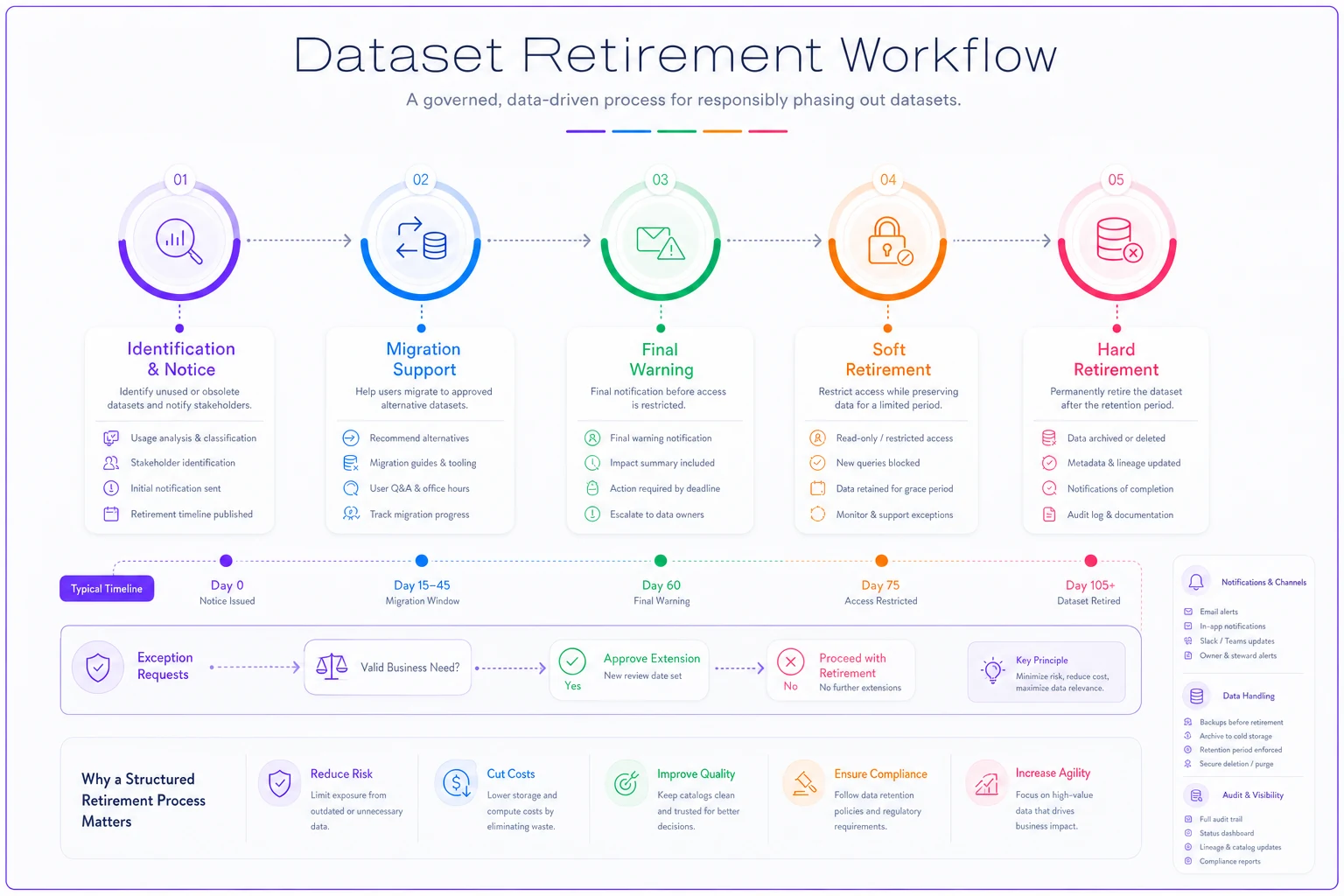
Making retirement systematic, not emotional, is the key. When everyone understands the process and criteria upfront, retirement becomes routine maintenance instead of a political battle.
Building this into your existing operations
The biggest mistake companies make is trying to implement all of this at once. Start with your most painful dataset - usually something in revenue, customer, or inventory data that multiple teams depend on.
Pick one dataset that causes frequent confusion. Apply the contract schema. Assign a clear owner. Set up basic monitoring. Run through one retirement cycle with an obviously obsolete dataset. Get these patterns working on a small scale before expanding.
For most mid-size companies (say 50-200 employees), you can implement basic dataset product management in about two months: Month 1: Identify Tier 1 datasets, assign owners, create initial contracts. Month 2: Build discovery patterns, implement retirement workflow for obvious candidates. Month 3+: Expand to Tier 2 datasets, refine processes based on feedback.
The operational impact becomes visible quickly. Teams stop wasting hours figuring out which dataset to use. Analytics becomes embedded in daily decisions because people actually trust the data. Critical metrics stay consistent across departments.
When AI automation transforms dataset management
This is where modern AI automation completely changes the game. Instead of manually maintaining contracts and tracking usage, AI-powered operational software can handle most of the dataset product lifecycle automatically.
Think about what currently requires manual work - tracking which datasets are actually being used, identifying downstream dependencies when something changes, monitoring quality and alerting on anomalies, generating and updating documentation, and suggesting retirement candidates.
AI agents excel at these pattern recognition and monitoring tasks. They can watch query patterns, automatically detect dependencies, and even generate initial contract drafts based on actual usage patterns. This isn't about replacing human judgment - it's about automating the tedious parts so your team can focus on strategic decisions.
An AI-powered platform might automatically detect that your customer segmentation dataset hasn't been queried in 75 days and proactively suggest retirement. Or it might notice that five different teams are creating similar datasets and recommend consolidation. These are exactly the kinds of operational improvements that compound over time.
The transformation happens when dataset management shifts from reactive firefighting to proactive optimization. Your data team spends less time investigating issues and more time improving core business datasets. The entire analytics function operates more like an internal service with clear products and delivery expectations.
Common objections and how to handle them
"This is too much overhead for our small team"
Start with just your top 5 datasets. The time you save from confusion and rework more than compensates for the initial setup. One retail analytics team found they were spending 8-10 hours per week just answering questions about which datasets to use. A few hours of setup eliminated most of those questions.
"Our data changes too fast for contracts"
Contracts define what won't change, not every detail. Focus on core guarantees like update frequency and primary fields. Everything else can evolve. The point is to be explicit about what users can depend on.
"Nobody will want to own datasets"
Make ownership meaningful, not burdensome. Give owners authority to make changes, recognition for improvements, and protected time for maintenance. When ownership comes with real influence over how data serves the business, people step up.
"We already have documentation"
Static documentation and dynamic contracts serve different purposes. Documentation explains what exists today. Contracts guarantee what users can depend on tomorrow. You need both to prevent metric sprawl and maintain operational trust.
The 6-month transformation timeline
Based on what I've observed across implementations, here's what you can realistically expect:
Month 1-2: Basic structure in place. Tier 1 datasets have owners and contracts. Early reduction in "which dataset?" questions.
Month 3-4: Discovery patterns established. First successful retirement. Users starting to trust the system. Data quality issues caught earlier.
Month 5-6: Full rhythm established. Most important datasets covered. Retirement process routine. Clear improvement in decision-making speed and accuracy.
By month six, the cultural shift is usually complete. Teams expect datasets to have owners. They check contracts before building dependencies. They trust that critical datasets won't suddenly disappear or change without warning.
One e-commerce company tracked their progress through support tickets. Month 1: 45 data-related confusion tickets. Month 6: 8 tickets, mostly about new requirements rather than confusion about existing datasets. That's roughly 40 hours per month saved just from reduced confusion.
Making dataset product management stick
The difference between companies that succeed with dataset product management and those that don't comes down to making it part of operational rhythm, not a special project.
Build it into existing processes. Quarterly planning includes dataset roadmaps. Sprint planning considers data dependencies. New projects specify required datasets upfront. Performance reviews recognize good dataset ownership.
Create feedback loops that reinforce good behavior - publicly celebrate successful retirements, track and share metrics on reduced confusion, highlight when good dataset management prevents issues, and make dataset quality visible in operations dashboards.
Most importantly, give it time to become habit. The first contract takes hours to write. The tenth takes 30 minutes. The first retirement feels risky. The fifth feels routine. These patterns need repetition to become natural.
The competitive advantage of trusted data
Companies with well-managed dataset products move faster. They make decisions with confidence instead of spending days validating numbers. They catch problems early instead of discovering them in board meetings. They scale operations without creating proportional data chaos.
This isn't about perfection. It's about creating enough structure that your data actively helps operations instead of hindering them. When analysts trust the data they're working with, when business teams can rely on consistent definitions across dashboards, and when changes happen predictably rather than mysteriously, the entire organization operates more smoothly. The time saved from confusion gets redirected toward actual business insights and improvements.
Ready to elevate your business intelligence?
Join 2,500+ businesses leveraging Glasaly to drive smarter decisions, improve team alignment, and boost operational performance.