


The fastest way to lose trust in your data isn't a broken pipeline. It's two people showing up to the same meeting with different numbers for "active customer" — and both of them being technically correct.
That's the real problem a semantic layer is supposed to solve. Not storage. Not query speed. Consistency of meaning across teams that don't talk to each other very often. And the reason most semantic layer projects underdeliver isn't the technology — it's that companies treat the semantic layer like a one-time definition exercise instead of something you roll out and maintain the way you'd roll out a code change.
A good semantic layer strategy is less about picking a tool and more about running the rollout like a controlled deployment: versioned definitions, tests that catch drift before it hits dashboards, staged promotion so a change to "gross margin" doesn't silently break the finance board, and a real answer to the question nobody asks until it's too late — how do we get every team to actually adopt the shared definition instead of building their own?
Here's how that whole system works when it's healthy, and the specific places it breaks when it isn't.
The failure pattern nobody names until year two
Here's the shape it usually takes. A company stands up a semantic layer, defines maybe 40–60 core metrics, gets everyone in a room, and celebrates. For about six months, things are great.
Then the erosion starts, and it's rarely dramatic. It looks like this:
-
Marketing needs "revenue" to exclude refunds for their attribution model, so someone forks the definition into
revenuenetmarketing. -
Finance updates the fiscal calendar mid-year and the change ripples into three metrics nobody remembered depended on it.
-
A new analyst joins, can't find the canonical "churn" definition fast enough, and writes their own in a dashboard.
-
An engineer renames an upstream column, and four semantic definitions break in ways that don't error — they just return slightly wrong numbers.
None of these is a crisis on its own. Together, eighteen months later, you've got the exact metric sprawl the semantic layer was supposed to prevent, except now it's hidden inside the layer instead of scattered across spreadsheets. That's worse, because people trust it more.
What shows up across a lot of these projects is that the semantic layer doesn't fail at definition time. It fails at change time. Nobody plans for how definitions evolve, so they evolve chaotically. If you've already dealt with the underlying taxonomy problem, the governance framework for an enforceable metric taxonomy is the foundation this whole rollout sits on — the semantic layer is how you operationalize that taxonomy across teams.
Treat the term catalog like a versioned artifact, not a wiki page
The first structural fix is the one people resist most, because it feels like overhead: your catalog of terms and metric definitions needs versions. Real ones. Not "last edited by" timestamps in a shared doc.
Stop missing critical business insights.
Glasaly helps you create, share, and track interactive dashboards effortlessly.
- Real-time data visualization
- Collaborative report sharing
- Customizable analytics widgets
No credit card required
A versioned term catalog means every definition — "active user," "billable hour," "unit contribution margin" — has:
-
a definition version number
-
the exact underlying logic tied to that version
-
a changelog explaining why it changed, not just what
-
a list of downstream consumers (dashboards, reports, models) that depend on it
The thing most teams miss: the value of versioning isn't the history. It's the dependency map. When you can see that changing the "active user" definition affects 11 dashboards, 2 exec reports, and a churn model, the conversation about whether to change it becomes real. Without that map, every definition change is a blind edit.
A typical example: a subscription business changes "active user" from logged in during the period to performed a core action during the period. Reasonable change. But it drops the active-user count by around 18%, and because nobody traced dependencies, the customer success team's health-score model — which used the old definition — starts flagging healthy accounts as at-risk. Three weeks of confused save-calls before anyone connects it back to the definition change.
Versioning wouldn't have prevented the change. It would have made the blast radius visible before the change shipped.
Store the dependency map alongside the versioned definition so reviewers can see the blast radius during a change review.
This is the same discipline that makes metric definitions safe to evolve in the first place, which is worth reading alongside the practical version-control workflow for metric definitions — the semantic catalog is essentially that workflow applied at the term level instead of the individual-metric level.
Parity and regression hooks: the tests that catch drift before humans do
If versioning is the accounting, parity tests are the alarm system.
There are two kinds of checks that matter, and they solve different problems:
Parity checks confirm that a metric returns the same value across the places it's consumed. If "monthly recurring revenue" resolves to one number in the finance dashboard and a different number in the board deck, a parity check catches it. These usually run as scheduled comparisons — same metric, multiple consumption paths, flag any divergence beyond a tolerance.
Regression checks confirm that a definition change didn't accidentally move a metric it wasn't supposed to touch. You snapshot the current values, apply the change in a staging environment, and diff. If "gross margin" was supposed to stay flat but moved 4%, something in the shared logic leaked.
| Check type | What it protects against | When it runs | Typical trigger for alert |
|---|---|---|---|
| Parity check | Same metric, different values across consumers | Scheduled (daily/hourly) | Divergence beyond tolerance |
| Regression check | Unintended changes from a definition edit | On every catalog change (pre-promotion) | Unexpected value shift in unrelated metrics |
| Freshness check | Stale definitions running on old logic | Scheduled | Definition version mismatch vs. source |
| Dependency check | Broken upstream columns/tables | On source schema change | Missing or renamed dependency |
Worth internalizing: parity tests catch problems in production, regression tests catch problems before production. Teams that only run parity checks are always reacting. Teams that add regression hooks to the promotion process catch most issues before a single dashboard updates.
One thing people get wrong here — they set tolerances too tight and get alert fatigue, or too loose and miss real drift. A workable starting point is tolerance based on materiality, not percentage. A 2% swing in a $50M revenue metric matters; a 2% swing in a support-ticket count often doesn't. Tune to the decision the metric drives, not to a universal threshold.
Staged promotion and rollback: don't ship definition changes straight to prod
This is where borrowing from software deployment pays off directly.
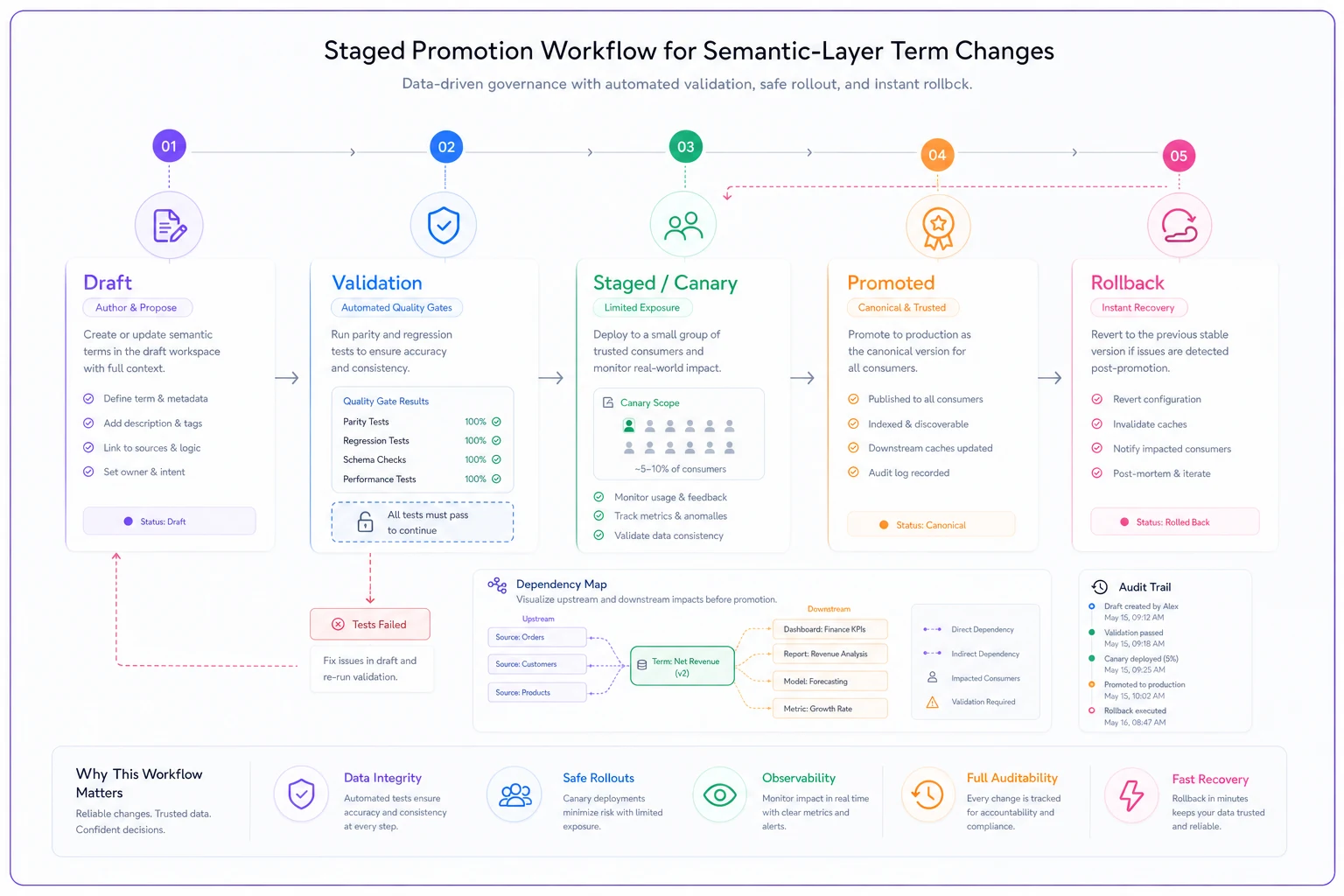
A definition change should move through stages, not jump straight into the layer everyone queries. The stages that actually work in practice:
-
Draft — the change exists in the catalog but isn't queryable by consumers. Author writes the definition and the changelog.
-
Validation — regression and parity checks run automatically against the proposed change. Dependency map gets regenerated. Anything unexpected blocks promotion.
-
Staged / canary — the new definition is exposed to a small set of consumers (often the data team's own dashboards, or one pilot team). Values are compared against the old version for a set window — say a week — to catch anything the automated checks missed.
-
Promoted — the change becomes the canonical definition. The old version is retained, marked deprecated, with a sunset date.
-
Rollback path — because the old version still exists, reverting is a version pointer change, not a scramble to reconstruct logic from memory.
The rollback piece is the part people skip and regret. If your only way to undo a bad definition change is to have someone rewrite the old logic from a Slack thread, you don't have a rollback plan — you have a recovery project.
A rule of thumb that saves a lot of pain: never delete a deprecated definition until every downstream consumer has migrated off it. Track migration explicitly. A definition marked deprecated for six months with three dashboards still pointing at it isn't deprecated — it's a landmine with a countdown you forgot about.
This staged approach maps closely to how you'd handle any shared data product, and the product-ready dataset approach with contracts and a retirement path covers the retirement discipline in more depth. Semantic terms deserve the same lifecycle rigor as datasets, because a consumed metric definition is a data product.
This diagram shows the staged promotion workflow.
The rollback piece is the part people skip and regret. If your only way to undo a bad definition change is to have someone rewrite the old logic from a Slack thread, you don't have a rollback plan — you have a recovery project.
The adoption problem: why the shared definition loses to the convenient one
The uncomfortable truth about semantic layers: the technical rollout is maybe 40% of the work. The other 60% is getting people to use the canonical definition when writing their own would be faster.
Analysts don't fork definitions out of malice. They do it because the canonical one is hard to find, slow to change, or doesn't quite fit their edge case — and they have a deadline. Every forked definition is a small vote against the shared layer, cast under time pressure.
You can't govern your way out of this with policy alone. You need the shared path to be the easy path. Adoption sticks when:
-
The canonical definition is easier to find and use than writing a new one from scratch.
-
Requesting a change to a definition has a real turnaround time — days, not "sometime."
-
Teams get credit, visibly, for using and contributing to shared definitions.
-
Someone owns each core metric and is reachable when it's confusing.
A few incentive patterns that actually move adoption:
-
Certification badges on dashboards built entirely from canonical definitions. Sounds trivial. Executives start asking why their dashboard isn't certified, and adoption climbs.
-
Fast-lane change requests for definitions, so people don't fork out of impatience. If a legitimate change takes a week to approve, forks are inevitable.
-
A visible "duplicate detector" that flags when someone's about to define something that already exists, at the moment they're doing it.
-
Consumption metrics on definitions — which terms get queried, which forks are proliferating — so governance targets the metrics people actually fight over instead of policing everything equally.
Adoption is a distribution problem, not a compliance problem. The shared definition doesn't win because it's mandated. It wins because it's the fastest correct answer available at the moment someone needs a number.
A real scenario: mid-size e-commerce operator
A retail-and-online business, roughly 120 people, was running analytics off a semantic layer they'd stood up about two years earlier. On paper, everything was defined. In practice, the finance, marketing, and operations teams were each quoting different numbers for "contribution margin" in the same weekly meeting.
The root cause wasn't complicated once they mapped it. Over two years, "contribution margin" had quietly spawned four variants — one that included fulfillment cost, one that didn't, one that used a stale shipping-cost assumption, and one built by an analyst who'd since left. All four lived inside or adjacent to the semantic layer. Nobody knew which was canonical.
What they changed, over about a quarter:
-
Consolidated to one canonical definition with a version number and a documented changelog.
-
Added parity checks across the three teams' primary dashboards, with tolerances tied to dollar materiality.
-
Put every future change through a validation-and-canary stage before promotion.
-
Set a two-day SLA on definition change requests, which killed most of the forking impulse.
The measurable result was less about a single number and more about meeting friction. The recurring "whose margin number is right" argument — which had been eating into nearly every leadership meeting — mostly disappeared within two months. They also caught two regression issues in the canary stage that would previously have shipped straight to the board deck. Time saved across analysts chasing reconciliation: somewhere around 20–25 hours a month that had been pure waste.
Nothing about that outcome required exotic technology. It required treating definitions as versioned, tested, and promoted artifacts instead of shared-doc entries.
When this level of rigor makes sense — and when it's overkill
Not every company needs staged promotion and canary windows for their metric definitions. Building this machinery for a 12-person startup with four metrics is a good way to waste a quarter.
When it's worth it:
-
Three or more teams consume the same metrics and disagree about them.
-
Definition changes have quietly caused wrong decisions before.
-
You have enough dashboards and models that dependency mapping isn't something a person can hold in their head.
-
Metrics feed anything external — board reports, investor updates, customer-facing numbers.
When it's overkill:
-
A small team where everyone knows every definition and changes are rare.
-
Early-stage, where definitions should be changing fast and heavy process would slow learning.
-
Cases where the real problem is upstream data quality, not definition consistency — different problem, different fix.
Who should not do this yet: if you haven't settled your metric taxonomy in the first place, adding versioning and parity tests on top of a chaotic definition set just makes the chaos more formal. Get the taxonomy stable, then add the rollout machinery. Order matters here.
The system view: how the pieces reinforce each other
Step back and the components aren't separate features — they're a loop.
The versioned catalog gives you the dependency map. The dependency map makes parity and regression tests meaningful, because you know what a change touches. Staged promotion uses those tests as gates, so bad changes stop before production. The rollback path exists only because versioning kept the old definition alive. And adoption incentives determine whether any of this matters — because a perfectly governed semantic layer that analysts route around is just an expensive museum piece.
Where the loop breaks tells you what to fix. If definitions drift despite tests, your parity tolerances are wrong or your coverage has gaps. If people fork constantly, your change SLA is too slow or the canonical path is too hard to find. If changes cause surprises, your dependency map is stale or your canary stage is too short. Each symptom points at a specific link in the chain.
That diagnostic clarity is the real payoff of building the semantic layer as a rollout system rather than a definitions project. You stop asking "why don't our numbers match" as an open-ended mystery, and start asking "which stage of the rollout let this through" — a question that has an answer and an owner.
The teams that keep their metrics consistent across three, five, ten groups aren't the ones with the strictest definitions. They're the ones who built a boring, repeatable process for how definitions change, get tested, get promoted, and get adopted — and then actually followed it, especially the last week before quarter-end when everyone's tempted to skip the canary stage. That temptation, and whether you resist it, is where consistency is actually won or lost.
The teams that keep their metrics consistent across three, five, ten groups aren't the ones with the strictest definitions. They're the ones who built a boring, repeatable process for how definitions change, get tested, get promoted, and get adopted — and then actually followed it, especially the last week before quarter-end when everyone's tempted to skip the canary stage. That temptation, and whether you resist it, is where consistency is actually won or lost.
Ready to elevate your business intelligence?
Join 2,500+ businesses leveraging Glasaly to drive smarter decisions, improve team alignment, and boost operational performance.