

The hardest part of analytics interoperability isn't getting two systems to read the same table. It's keeping them reading it the same way six months later — after three schema changes, two new consumers, and one well-meaning engineer who renamed a column because the old name "wasn't clear."
Most teams discover this the hard way. A dataset works fine when one Looker dashboard and one Python notebook depend on it. Then finance builds a Power BI model on top, a reverse-ETL job starts syncing it to Salesforce, and suddenly a nullable change that seemed harmless on Tuesday breaks three downstream things by Thursday. Nobody signed up to coordinate all of that, so it falls apart quietly until a VP's revenue number doesn't match.
This post is about treating datasets like APIs with real contracts — versioned, testable, and gated — so that interoperability is enforced by the system instead of by heroics. The patterns below are the ones that hold up when the number of consumers grows past what any one person can track in their head.
Why interoperability breaks even when everyone is careful
The usual assumption is that breakage comes from careless people. In practice, it comes from missing structure. Each consumer makes reasonable assumptions about a dataset — column types, grain, freshness, what "active_customer" means — and none of those assumptions are written down anywhere the producer can see.
A typical example: an ordersdaily table has a column status. The BI team assumes it only ever contains paid, refunded, and cancelled. The pipeline team adds a fourth value, partiallyrefunded, which is technically correct and doesn't touch the schema at all. No type changed, no column was dropped. But a dashboard summing paid orders now silently undercounts revenue, because the new status was previously folded into refunded upstream.
That's the thing about analytics interoperability dataset APIs — the schema is the easy part. The contract has to cover the meaning, the grain, the allowed values, and the freshness, because those are what consumers actually depend on. Schemas catch maybe a third of real breakages. The rest come from semantic drift that passes every type check.
What breaks at scale is coordination. With three consumers you can send a Slack message before changing anything. With thirty, you don't even know who they all are. The producer has no visibility into who reads the dataset, and the consumers have no guarantee the producer won't change it. Both sides are flying blind, and the only feedback loop is a broken dashboard.
The contract as the unit of agreement
A dataset contract is a machine-readable file that lives next to the dataset and describes everything a consumer is allowed to rely on. If it's not in the contract, it's not guaranteed. If it is in the contract, changing it is a governed event. That single rule — guarantees are explicit — is what makes the rest of the system work.
Stop missing critical business insights.
Glasaly helps you create, share, and track interactive dashboards effortlessly.
- Real-time data visualization
- Collaborative report sharing
- Customizable analytics widgets
No credit card required
Here's a contract structure that holds up well in practice. This is a YAML example for an orders dataset:
| YAML |
|---|
| dataset: ordersdaily version: 2.3.0 owner: data-platform@company.com description: One row per order per day, settled transactions only. grain: - orderid - eventdate freshness: maxlagminutes: 90 measuredfrom: eventdate sla: "95% of partitions land within 90 min of source close" schema: - name: orderid type: string nullable: false pii: false - name: eventdate type: date nullable: false - name: customerid type: string nullable: false pii: true - name: status type: string nullable: false allowedvalues: [paid, refunded, cancelled, partiallyrefunded] - name: grossamount type: decimal(12,2) nullable: false unit: USD - name: netamount type: decimal(12,2) nullable: true unit: USD semantics: activeorder: "status IN ('paid','partiallyrefunded')" revenuebasis: "netamount where status != 'cancelled'" compatibility: breakingchanges: - removecolumn - narrowtype - addrequiredcolumn - removeallowedvalue - tightennullability nonbreakingchanges: - addnullablecolumn - addallowedvalue - widentype - loosennullability |
Notice what this does beyond schema. The allowedvalues on status would have caught the revenue bug described earlier — adding partiallyrefunded is declared non-breaking only because the contract explicitly lists addallowedvalue as safe and defines active_order in terms the consumer can bind to. The semantics block means a dashboard doesn't have to guess what counts as revenue. The unit: USD field prevents the currency-mixing problems that quietly corrupt cross-region reporting.
The compatibility block is the most underused part. It encodes, per dataset, which change categories break consumers and which don't. That's what lets you automate the next piece.
Semantic versioning that actually maps to consumer impact
SemVer gets thrown around loosely for datasets, so pin it to consumer impact — not to how big the change feels to the producer.
| Change | Version bump | Why |
|---|---|---|
| Drop a column | MAJOR | Any consumer selecting it breaks |
| Narrow a type (decimal → int) | MAJOR | Data loss, parse failures downstream |
| Remove an allowed value | MAJOR | Filters assuming it was possible may misbehave |
| Add a required column | MAJOR | Writers and some validators fail |
| Tighten nullability (nullable → not null) | MAJOR | Fine for readers, breaks writers and backfills |
| Add a nullable column | MINOR | Existing queries unaffected |
| Add a new allowed value | MINOR | Only breaks consumers with closed-world assumptions |
| Widen a type (int → bigint) | MINOR | Backward compatible for readers |
| Fix a description, add a tag | PATCH | No data or shape change |
The nuance most teams miss: adding an allowed value is MINOR, but only if consumers have been told not to assume a closed set. That assumption has to live in the contract too. If a consumer explicitly pins to a fixed enum, that's a separate, stricter contract — and the producer needs to know it exists. This is the same discipline that makes version control workflows for metric definitions reliable: the version number is a promise about behavior, not a changelog label.
One practical rule that saves a lot of pain: never reuse a MAJOR version to make "a small breaking change." If it's breaking, it's a new major, full stop. Teams that fudge this end up with a 2.0 that means three different things depending on when you consumed it.
Runtime compatibility checks
A contract that only exists in a repo is documentation, not enforcement. The checks have to run at three points: when the producer builds the dataset, when a consumer onboards, and continuously after that.
Producer-side checks run in the pipeline before data is published. The build compares the actual output against the contract — does every column match the declared type, are non-nullable columns actually non-null, do all status values fall inside allowed_values, is the grain actually unique. A violation fails the build instead of poisoning downstream.
Consumer-side checks run when a new consumer registers against the dataset. This is where you catch a BI model that assumes a tighter schema than the contract guarantees. If the Power BI model requires net_amount to be non-null but the contract says nullable, that mismatch surfaces at onboarding, not at month-end close.
Continuous checks verify the live dataset against its contract on a schedule — freshness lag against the SLA, row-count sanity, allowed-value drift. These are closely related to data quality and observability work generally; the difference here is that the contract is the source of truth for what "correct" means, so there's no argument about thresholds.
A minimal check contract for a consumer might look like this:
| YAML |
|---|
| consumer: financerevenuemodel consumes: ordersdaily pinnedversion: ">=2.0.0 <3.0.0" requires: columns: [orderid, eventdate, netamount, status] nonnull: [netamount] # stricter than producer contract closedenum: status: [paid, refunded, cancelled] # WARNING: will break on new values maxlagminutes: 120 |
The compatibility engine reads both files and flags the two conflicts immediately: net_amount is nullable in the producer contract but required here, and status is declared closed by this consumer even though the producer reserves the right to add values. Neither is necessarily wrong — but both need to be a decision, made before the consumer goes live, not a surprise.
Consumer onboarding: the checklist that prevents most incidents
When a new consumer wants to depend on a dataset, run them through a fixed onboarding sequence. This is the single highest-leverage habit for interoperability, because it forces assumptions into the open at the one moment when it's cheap to fix them.
Most interoperability incidents aren't caused by the change itself. They're caused by nobody knowing a consumer existed, or by a stricter assumption that was never written down. Onboarding is where you catch both.
-
Register the consumer against the dataset so the producer knows it exists. An unregistered consumer is an invisible one.
-
Declare the version range you'll accept, including the upper bound. No open-ended
>=pins. -
List the exact columns and semantics you depend on. If you rely on the
revenue_basisdefinition, name it, so a change to that definition triggers a notification to you. -
State any stricter-than-contract requirements (non-nullability, closed enums, tighter freshness) explicitly. These are the silent killers.
-
Run a compatibility dry-run against current production data before going live.
-
Subscribe to the dataset's change channel so version bumps reach a human who owns the downstream.
Skipping any of these steps doesn't save time — it just moves the cost to later, when it's harder to fix and more people are affected.
Promotion gates: how changes move without breaking people
Changing a widely-used dataset should feel a little like deploying code — because it is. The gates below move a change from proposal to production in a controlled way.
The gate sequence automates classification, testing, and notification so only genuine breaking changes require human sign-off.
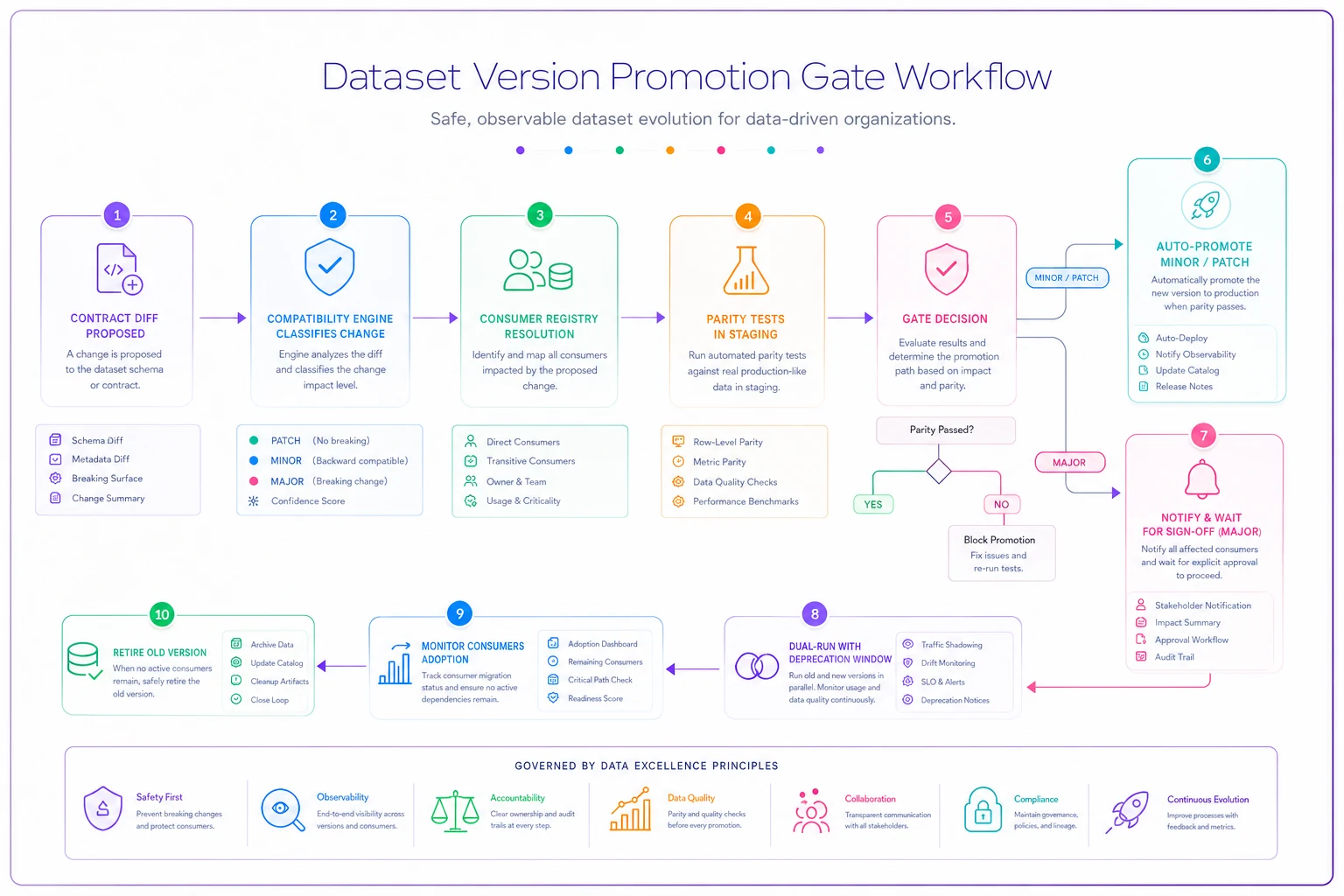
That dual-run window is what separates teams that ship breaking changes calmly from teams that dread them. The deprecation-and-retirement mindset here connects directly to treating datasets as products with a real retirement path — a dataset version is a product release, and killing it before consumers move off is how you create the 2 a.m. incidents.
| Flow |
|---|
| [Contract diff proposed] ↓ [Compatibility engine classifies: PATCH / MINOR / MAJOR] ↓ [Consumer registry resolves affected consumers] ↓ [Parity tests run in staging against real data] ↓ [MINOR/PATCH: auto-promote if parity passes] [MAJOR: notify affected consumers → wait for sign-off] ↓ [Dual-run: publish new version alongside old, deprecation window opens] ↓ [Registry confirms zero active consumers on old version → retire] |
Parity tests are worth calling out specifically. Materialize the new version against real data and diff key aggregates against the current version. If total revenue shifts by more than a small expected delta, the gate holds. This catches semantic changes that pass every schema check — the kind that are hardest to find after the fact.
A real scenario
A mid-sized e-commerce operation — roughly 40 people, a data team of three — had an orders dataset feeding a Looker revenue dashboard, a finance Excel export, and a reverse-ETL sync into their email tool. No contracts. Over about four months they had three separate revenue-mismatch incidents, each eating a day or two of investigation and a round of "whose number is right" meetings with finance.
The pattern was always the same: an upstream change that looked safe to engineering but violated an unwritten assumption downstream. One was a timezone shift on event_date that moved revenue across day boundaries. One was a new order status. One was a column rename.
They introduced contracts for the three most-depended-on datasets, a consumer registry, and parity tests in the promotion gate. It took about two weeks of setup and some grumbling. Over the following quarter they had one near-miss — caught at the promotion gate before it shipped — instead of three production incidents. The finance reconciliation meetings, which had been running close to an hour each, basically stopped. The time saved wasn't dramatic in isolation, but the trust it rebuilt with finance was the real payoff.
Where this fits, and where it doesn't
When this actually makes sense: when a dataset has more than two or three consumers, when those consumers span different tools (BI plus pipelines plus reverse-ETL), or when a wrong number has real consequences — revenue, compliance, anything a board sees. The more diverse the consumers, the more contracts earn their keep.
When this is overkill: a scratch dataset one analyst uses for a single exploration doesn't need a versioned contract. Neither does a dataset you expect to throw away in a month. Forcing contracts onto genuinely exploratory work just slows people down and teaches them to route around the system.
Who should not start here: teams that haven't yet decided where their canonical datasets live. If you're still replicating the same table across three warehouses with no clear source of truth, contracts will just multiply the confusion. Sort out the centralize-versus-replicate decision first, then put contracts on the canonical copies. Contracts layered on top of an unresolved architecture just give you more things to keep in sync.
Making governance enforceable without a committee
The failure mode of dataset governance is that it becomes a review board — a meeting where changes wait for approval and everyone resents it. The whole point of contracts, version rules, and automated gates is to replace that human bottleneck with checks that run on their own.
This is where lightweight automation genuinely earns its place. A workflow platform that watches contract diffs, classifies them, resolves affected consumers from the registry, runs parity checks, and routes only the genuinely breaking changes to a human — that's the difference between governance that scales and governance that becomes the thing everyone avoids. The automation isn't the interesting part; the contracts are. The automation just makes sure the contracts get enforced every single time instead of only when someone remembers.
The teams that get interoperability right aren't the ones with the strictest rules. They're the ones who made the right behavior the path of least resistance — where publishing a dataset without a contract is harder than publishing one with it, and where a breaking change can't quietly reach production because the gate won't let it through.
Analytics interoperability isn't a tooling problem you solve once. It's a coordination problem that reappears every time a new consumer shows up or a producer changes their mind. Contracts, honest semantic versioning, runtime checks, and promotion gates don't eliminate change — they make change legible, so that a modification to a dataset is a visible, governed event instead of a time bomb with a random fuse.
Start with your two or three most-depended-on datasets. Write the contract, stand up a consumer registry, and put a parity test in front of promotion. You won't catch everything on day one, but you'll move from discovering breakage in production to catching it at the gate — and that shift, more than any single tool, is what makes datasets you can actually build on.
Ready to elevate your business intelligence?
Join 2,500+ businesses leveraging Glasaly to drive smarter decisions, improve team alignment, and boost operational performance.