



Most teams don't choose to run analytics across multiple warehouses. It happens to them. Marketing spins up BigQuery because the ad platforms export there cleanly. Finance lives in Snowflake because that's what the vendor set up. Then an acquisition drags in a Redshift cluster, and suddenly you have three sources of truth for "revenue" that disagree by a few percent — and no one can say which one is right.
The instinct is to pick one warehouse and force everything into it. Sometimes that's the right call. Often it isn't, and the migration burns two quarters and delivers something slower and more expensive than what you started with. The real skill in cross-warehouse governance isn't consolidation for its own sake. It's knowing, table by table and metric by metric, when to centralize a dataset into one canonical home and when to replicate it deliberately with tight sync rules.
This piece is a decision framework for exactly that. Not a migration guide — a governance matrix you can apply to individual datasets so you stop making the choice by gut feel.
Start with the failure mode
Before the matrix, it's worth being honest about how these environments actually break. The pattern is pretty consistent.
A dataset gets replicated into a second warehouse "temporarily" so a team can join it against local data. The copy job is a scheduled query someone wrote on a Thursday afternoon. Six months later that copy is powering a board deck. The original table changed its order_status enum, the copy didn't, and now the finance dashboard counts refunds as completed sales. Nobody notices until the numbers are off by enough to trigger a meeting.
The opposite failure looks different but hurts the same. A team over-centralizes — insists every query hit the one canonical warehouse — and now a marketing analyst running a simple cohort pull is cross-region querying a 4TB table on every dashboard refresh. The bill climbs, queries queue, and people start exporting to spreadsheets just to get their work done. You've protected consistency and destroyed usability.
So the two things you're actually governing are: drift (replicated data silently diverging from source) and friction and cost (centralized data being too slow or expensive to use where it's needed). Every decision below trades one against the other.
The decision matrix
For any given dataset, score it against these dimensions and the recommendation usually becomes obvious.
Stop missing critical business insights.
Glasaly helps you create, share, and track interactive dashboards effortlessly.
- Real-time data visualization
- Collaborative report sharing
- Customizable analytics widgets
No credit card required
| Dimension | Lean toward **centralize** when… | Lean toward **replicate** when… |
|---|---|---|
| Update frequency | Data changes constantly (transactional, event streams) | Data is slow-moving (dimension tables, reference data) |
| Consistency stakes | It feeds financial or regulatory reporting | Minor lag or drift is tolerable |
| Query locality | Consumers are mostly in one warehouse | Heavy consumers live in a different warehouse |
| Join patterns | It's rarely joined to warehouse-local data | It's constantly joined to local tables |
| Data volume | Small-to-medium, cheap to query remotely | Large enough that cross-warehouse egress hurts |
| Ownership clarity | One team clearly owns it | Ownership is genuinely shared |
The mistake teams make is scoring a dataset on one of these dimensions and stopping. A customer dimension table might be slow-moving (points to replicate) but also feed regulated revenue reporting (points to centralize). When dimensions conflict, consistency stakes win. Cost is recoverable. A wrong number in a compliance report is not.
Choosing a canonical source (and actually enforcing it)
Replication without a declared canonical source is just chaos with extra copies. The canonical source is the one warehouse and table that is defined as correct. Every replica is downstream of it and is allowed to be stale, but never allowed to be authoritative.
-
The canonical source is where the data is written, not where it's most convenient to read. If your order events land in Snowflake first, Snowflake is canonical for orders even if 80% of your analysts work in BigQuery. Fighting this creates write-back loops that nobody can debug.
-
A dataset gets exactly one canonical home. Not one per region, not one per team. The moment you have two "canonical" copies, you have zero.
-
Replicas must be labeled as replicas. Table naming, metadata tags, whatever your catalog supports — a consumer should be able to tell instantly whether they're on source or copy. This connects directly to treating datasets like products with clear contracts, which we covered in making datasets product-ready. A replica without a documented contract is a landmine.
A pattern worth naming: teams often pick canonical source based on who set up the pipeline first, not on where the data originates. That's how you end up with a marketing team's ETL output being treated as the source of truth for customer records, while the actual system-of-record sits ignored two hops upstream.
Sync hygiene: the part everyone underinvests in
If you're going to replicate, the sync mechanism is where governance actually lives or dies. Most drift disasters trace back to a sync job that was correct on day one and never revisited.
A workflow that keeps replicas honest without heavy tooling:
-
Declare the sync contract. Frequency (every 15 min? nightly?), acceptable lag, and which columns are in scope. Write it down where the consumers can see it.
-
Emit a freshness marker. Every synced table gets a
lastsyncedatcolumn or sidecar metadata row. Consumers and dashboards can check it. A replica with no freshness signal is untrustworthy by default. -
Run parity checks on the join keys and critical columns. Not full-table comparisons — that's expensive. Compare row counts, a checksum of critical columns, and the max updated timestamp between source and replica on a schedule.
-
Alert on schema drift at the source. The most dangerous change isn't stale data, it's the source adding or renaming a column that the sync silently drops. Watch the source schema, not just the replica.
-
Define a break-glass behavior. When parity fails, does the replica get flagged as stale, or does the pipeline halt? Decide in advance. Silently serving a broken replica is the worst option and the default in most setups.
Here's a simple workflow visualization.
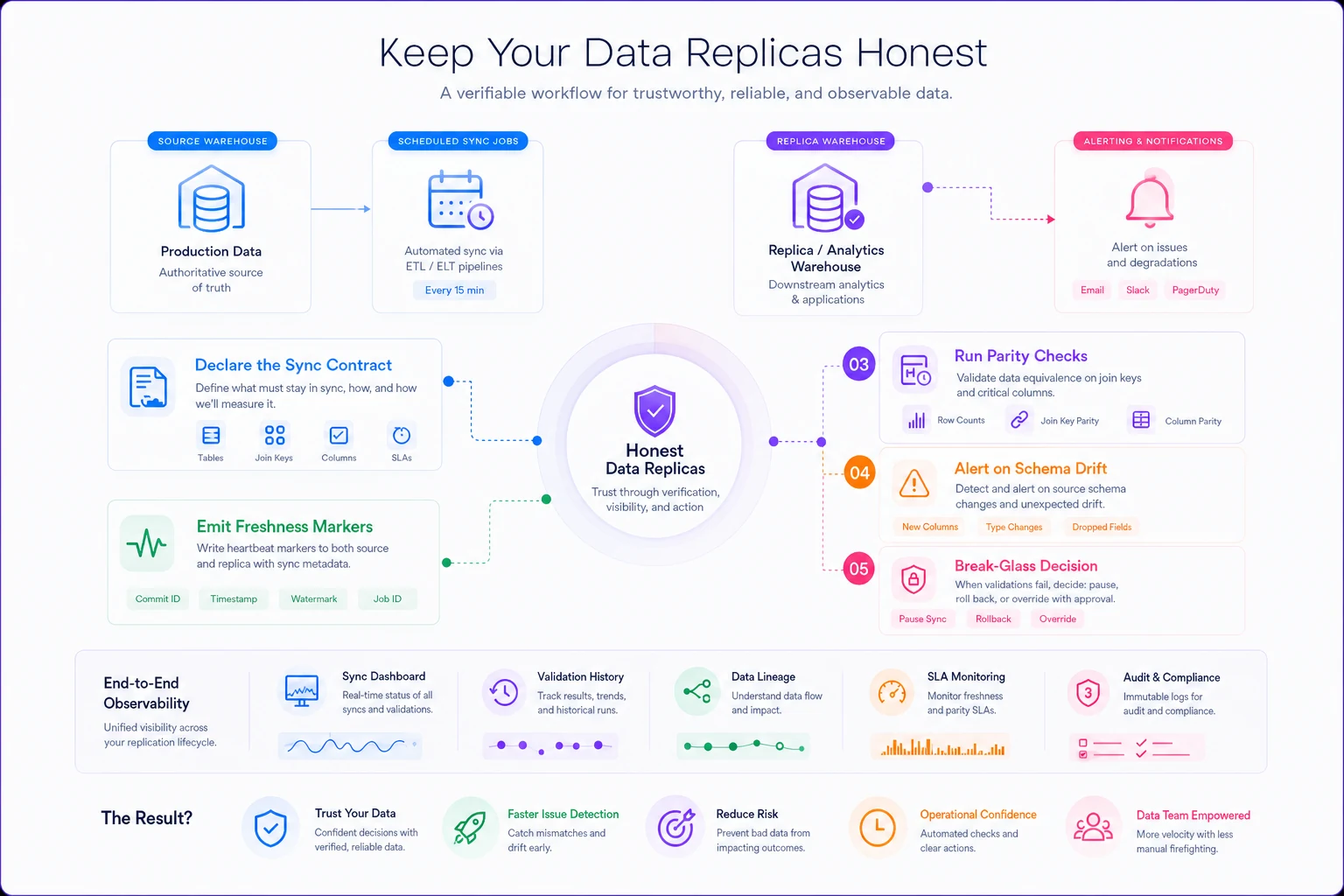
Put the freshness marker where dashboards can query it directly so analysts see staleness without opening tickets.
Teams tend to obsess over sync frequency and ignore sync validation. Running a copy every 5 minutes feels safe, but a fast pipeline copying a broken transform just spreads the error faster. Validation matters more than freshness for most datasets.
Cost governance in hybrid environments
Cross-warehouse setups leak money in ways single-warehouse teams never see. The two big ones:
Egress and cross-region query costs. Querying a Snowflake table from a BigQuery federated query, or moving large result sets between clouds, gets billed in ways that don't show up on your main warehouse dashboard. A single unoptimized cross-cloud dashboard refreshing hourly can quietly run into the low thousands per month.
Redundant compute from over-replication. Every replica needs a sync job, and sync jobs run compute on both ends. Replicate ten large tables you didn't need to, and you're paying for the copy and the scan and the storage, three times over.
The controls that actually work here overlap heavily with general spend discipline — we went deep on the enforceable version of this in stopping runaway analytics costs. For the cross-warehouse-specific angle, add these:
-
Tag every replica with its monthly sync cost so the owning team sees what the convenience actually costs.
-
Set a size threshold
any table above a certain volume requires explicit sign-off before it gets replicated rather than queried in place.
-
Review replicas quarterly and kill the ones no dashboard has touched in 60 days. Dead replicas are pure cost.
When centralizing actually makes sense
Centralize when the data is transactional and consistency is non-negotiable — orders, payments, inventory movements, anything feeding financial close. Centralize when a dataset has one clear owner and its consumers are mostly in the same warehouse anyway. And centralize when the volume is small enough that a remote query costs pennies; there's no reason to copy a 50k-row reference table when you can just query it in place.
When replicating is the right call
Replicate when a large, slow-moving table is repeatedly joined against warehouse-local data by teams in a different warehouse. Reference data, geography lookups, product catalogs — things that change weekly and get joined constantly. The cost of copying nightly is trivial compared to the cost of cross-warehouse joins on every dashboard load.
Who should not be building this
If you have one warehouse and one team, none of this applies — don't manufacture complexity. And if your "multi-warehouse" situation is really one warehouse plus a handful of CSV exports someone treats as a database, fix that first. This matrix is for teams with genuine, sustained analytics load across two or more platforms, not for teams avoiding a straightforward consolidation.
A real scenario
A mid-sized ecommerce operation — around 40 people, two warehouses after acquiring a smaller brand. Orders lived in Snowflake (the parent's system), while the acquired brand's marketing and web analytics ran in BigQuery. The marketing team needed order data to calculate CAC and cohort revenue, so someone set up an hourly copy of the orders table into BigQuery.
For a while it worked. Then the Snowflake side added a partial-refund status to the order enum. The BigQuery copy job used a hardcoded WHERE status IN (...) filter and silently dropped the new status. Refunded-then-partially-restocked orders vanished from marketing's revenue math. The gap was small at first — maybe a percent or two — but it grew as partial refunds became more common, and by the time anyone caught it the reported CAC was off by somewhere around 8–12% across two months of budget decisions.
The fix wasn't fancy. They declared Snowflake canonical for orders, stopped copying with a hardcoded status filter, added a parity check comparing daily order counts and total revenue between source and replica, and put a freshness timestamp on the BigQuery copy that marketing dashboards now display. Sync cost went up slightly because they widened the columns being copied. The value of not making budget decisions on wrong numbers made that irrelevant.
What's easy to miss in that story: the pipeline didn't break loudly. It kept running successfully while producing wrong output. That's the signature of a governance gap, not a technical failure. The data looked fine. The downstream decisions weren't.
How to actually roll this out
You don't audit every table at once. Start where the pain is.
-
List every dataset that currently exists in more than one warehouse.
-
For each, identify the canonical source. If you can't, that dataset is your first problem.
-
Score the top 10 by consumption against the matrix above.
-
Flag any replica with no freshness marker and no parity check — those are your active risks.
-
Kill anything nobody's queried in two months.
-
Write down the sync contract for whatever survives.
That's roughly a week of work for most teams, and it surfaces the datasets that are one schema change away from embarrassing someone in a leadership meeting.
Cross-warehouse governance isn't a migration project and it isn't a tooling purchase. It's a set of per-dataset decisions — centralize or replicate, which source is canonical, how sync gets validated, what the copy costs — made deliberately instead of by accident.
The teams that get burned aren't the ones running multiple warehouses. They're the ones running multiple warehouses without ever deciding, for each dataset, which copy is allowed to be wrong. Work through the matrix on your ten heaviest datasets. You'll almost certainly find at least one replica quietly feeding a decision it was never meant to support.
Ready to elevate your business intelligence?
Join 2,500+ businesses leveraging Glasaly to drive smarter decisions, improve team alignment, and boost operational performance.