

Most teams don't choose an analytics platform. They accumulate one. Somebody spins up a warehouse for a dashboard, someone else adds a streaming pipeline for a "real-time" requirement that turned out to be a vanity metric, and two years later you're paying for three overlapping systems nobody fully understands. By the time anyone asks whether the architecture actually fits the business, switching costs have quietly locked you in.
What makes analytics platform sourcing genuinely hard isn't a lack of options — it's that the right answer shifts depending on where your business actually sits, and most decision frameworks ignore that entirely. A pattern that's perfectly reasonable for a company doing hourly batch loads becomes an expensive mistake when you're genuinely latency-constrained, and vice versa. The goal here is to give you a way to map four variables — maturity stage, freshness needs, cost tolerance, and operational capability — onto architecture patterns and vendor choices you can defend in a budget review six months from now.
This is a decision guide, not a product comparison. No single vendor wins across stages, and anyone telling you otherwise is selling something.
The four variables that actually determine your sourcing decision
Before you look at a single vendor, you need honest answers to four questions. The mistake most teams make is answering the aspirational version instead of the real one.
1. Maturity stage. Where are you on the curve from "a few analysts running SQL" to "a platform team serving dozens of downstream consumers"? This maps closely to the operating-model work we laid out in a stage-based analytics maturity blueprint with evolving SLA rules — your sourcing decisions should follow your maturity, not leapfrog it.
2. Latency and freshness needs. Not what the loudest stakeholder says they need. What decisions actually break if data is an hour old instead of five seconds old? In practice, the number of genuinely sub-minute use cases is far smaller than anyone claims up front.
3. Cost tolerance. This has two layers: how much you can spend, and how volatile that spend is allowed to be. A platform that costs the same every month but runs slightly higher is often better for a small finance team than one that's cheaper on average but spikes unpredictably.
4. Operational capability. How many people can actually run, debug, and maintain the thing at 11pm when a pipeline fails? This is the variable teams lie to themselves about most. A brilliant architecture that requires three dedicated platform engineers is worthless if you have one analyst who also owns the dashboards.
The trap is optimizing one variable in isolation. Freshness obsession without the capacity to maintain streaming infrastructure produces fragile systems. Cost minimization without regard to maturity produces platforms you outgrow in nine months.
The core decision matrix
Below is the mapping worth returning to. Read it as "if these conditions hold, this pattern is defensible" — not as a ranking.
Stop missing critical business insights.
Glasaly helps you create, share, and track interactive dashboards effortlessly.
- Real-time data visualization
- Collaborative report sharing
- Customizable analytics widgets
No credit card required
| Stage | Freshness need | Cost tolerance | Op capability | Defensible pattern | Sourcing approach |
|---|---|---|---|---|---|
| Early (1–3 analysts) | Daily / hourly batch | Low, wants predictability | 1 part-time owner | Single managed warehouse + scheduled transforms | Fully managed cloud warehouse, usage-capped |
| Growing (small data team) | Mostly hourly, a few near-real-time | Moderate, some volatility OK | 1–2 dedicated people | Managed warehouse + lightweight ELT + a narrow streaming path | Managed warehouse + managed ingestion vendor |
| Scaling (platform forming) | Mixed batch + genuine streaming | Higher, wants efficiency at volume | Small platform team | Warehouse + lakehouse tier + isolated streaming service | Mix of managed + self-run for the hot path |
| Mature (platform team) | Tiered by use case | Optimizing unit economics | Dedicated platform + on-call | Lakehouse with workload isolation, governed multi-engine | Best-of-breed, negotiated commitments |
A few things worth saying out loud about this table.
The jump people get wrong most often is Early → Growing. They see "a few near-real-time" needs and immediately reach for a full streaming platform, when the honest move is one narrow streaming path bolted onto an otherwise batch system. You don't rebuild the house because one room needs faster plumbing.
The Scaling row is where most expensive mistakes live. This is the stage where you're big enough to feel real pain but not big enough to have an actual platform team, and vendors are circling with enterprise pitches. Resist buying for the stage you hope to reach.
Latency tiers: what freshness actually costs you
The cleanest way to avoid overbuying is to force every data consumer to place their use case into a freshness tier, then price each tier. When people see the cost attached to "real-time," most quietly downgrade.
-
Tier 0 — Sub-minute (streaming) Fraud signals, live operational alerting, anything where a human or system acts within seconds. Expensive to run and maintain. Keep this list short and defend it.
-
Tier 1 — Minutes (micro-batch) Operational dashboards people watch during a shift. Usually satisfiable with frequent micro-batches, not true streaming.
-
Tier 2 — Hourly Most operational analytics. The sweet spot for cost and reliability.
-
Tier 3 — Daily Finance, reporting, most executive views. Cheap, stable, boring in the good way.
A typical example: a mid-sized ops team insisted they needed "real-time inventory." After tiering, exactly one use case — detecting stockouts during peak sales hours — actually justified Tier 0. Everything else fit comfortably in Tier 1 or 2. That single clarification cut their proposed streaming scope by roughly 70% and brought a six-figure annual line item down to something that fit the budget.
The SLA/cost tradeoff you're actually signing up for
| Freshness tier | Relative run cost | Operational burden | Failure blast radius |
|---|---|---|---|
| Sub-minute | Highest | On-call required | High — breaks are visible immediately |
| Minutes | High | Needs monitoring | Medium |
| Hourly | Moderate | Low | Low — buffer to catch issues |
| Daily | Lowest | Minimal | Very low |
Notice the last column. Freshness doesn't just cost money — it shrinks your margin for error. An hourly pipeline that fails gives you time to notice and fix before anyone downstream is hurt. A streaming pipeline that fails is a live incident. That's an operational tax, not just a compute tax.
Matching patterns to operational capability
This is the variable that quietly sinks more sourcing decisions than cost ever does. A pattern you can't operate is worse than a simpler one you can.
-
One part-time owner Fully managed everything. You want a vendor whose job is to keep it running so your person can focus on analysis. Self-hosted anything is a trap here.
-
One to two dedicated people Managed core, with maybe one specialized managed service for ingestion or transformation. Avoid running your own orchestration if you can buy it.
-
Small platform team (3–5) Now you can self-run selective components — usually the hot streaming path where control matters — while keeping the warehouse managed.
-
Dedicated platform team with on-call You've earned the right to best-of-breed and self-managed components, because you have the people to absorb the maintenance.
The pattern that fails repeatedly: a Growing-stage team hires one strong engineer, that engineer builds an elegant self-managed stack, then leaves. Suddenly nobody can debug it. Capability isn't just headcount — it's redundant headcount. If exactly one person can fix a system, your real operational capability for that system is effectively zero.
Ensure at least two people can operate any self-managed component before you commit to it.
If exactly one person can fix a system, your real operational capability for that system is effectively zero.
Migration and rollback maps
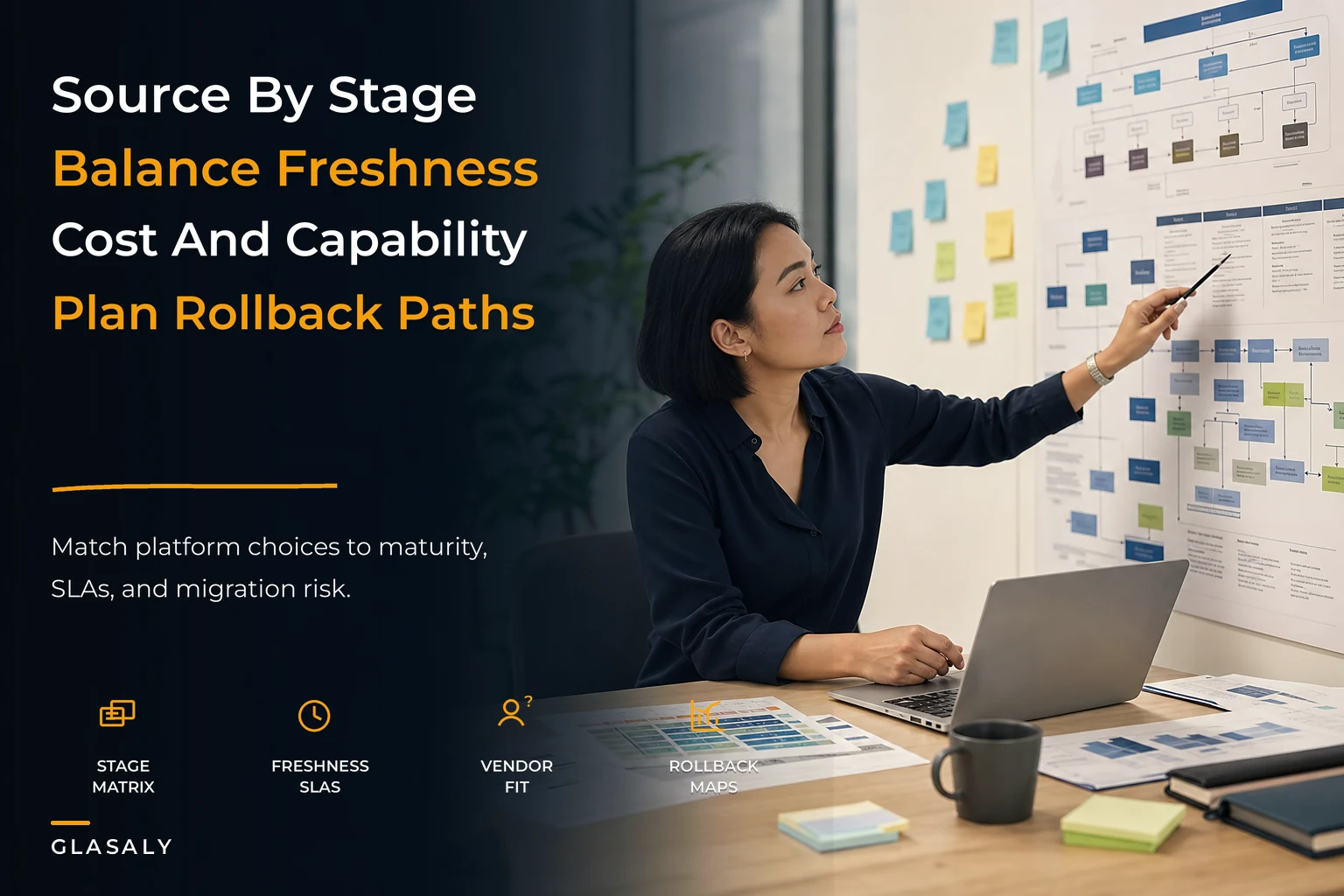
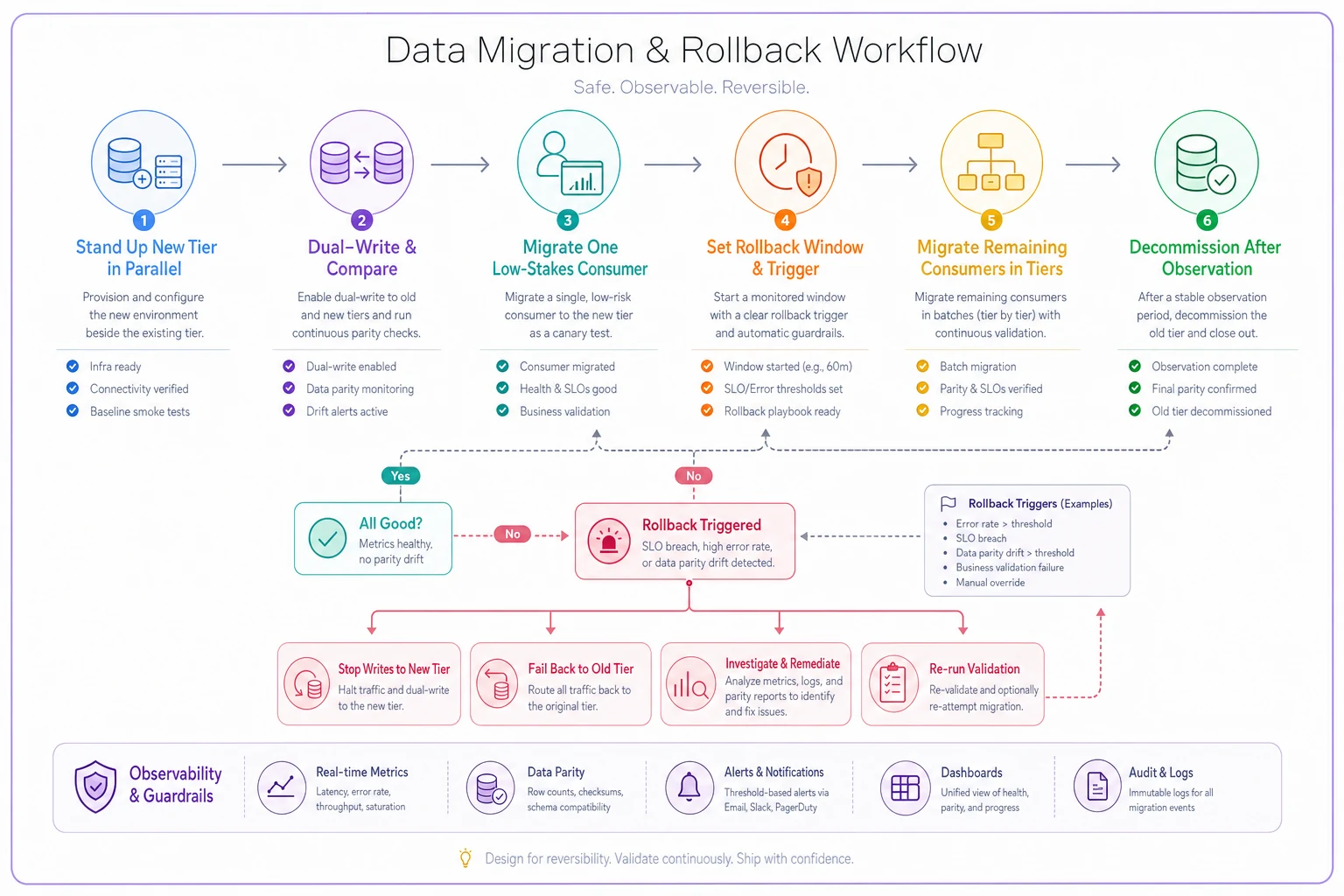
Sourcing isn't a one-time decision — it's a series of transitions. The teams that stay sane treat every move between patterns as something with an explicit rollback path. If you can't undo it within a defined window, you don't move yet.
-
Stand the new tier up in parallel. Never cut over cold. Run the new streaming or lakehouse path alongside the existing batch system with no consumers on it yet.
-
Dual-write and compare. Feed both systems and run parity checks on a sample of metrics. This is the same discipline from treating datasets as products — define the contract before anyone depends on it, which ties back to making datasets product-ready with contracts and a lightweight retirement path.
-
Migrate one low-stakes consumer. Pick an internal dashboard nobody panics over. Watch it for a full cycle.
-
Set a rollback window. Define, in writing, how long you keep the old path warm and the exact trigger to flip back. "If parity drifts beyond X for Y hours, we revert."
-
Migrate remaining consumers in tiers. Lowest-stakes first, Tier 0 last.
-
Decommission only after a clean observation period. Keeping the old path alive one extra month is cheap insurance.
A migration sequence that holds up in practice when moving from a single warehouse to a tiered setup:
Here's a simple visual of a migration workflow and rollback points.
Rollback map essentials
-
Trigger The specific condition that forces a rollback (parity breach, latency SLA miss, cost spike).
-
Owner The one person authorized to pull the trigger. No committees during an incident.
-
Window How long the old system stays runnable in parallel.
-
Cost of keeping both The monthly bill for running two systems — so finance isn't surprised and nobody rushes the cutover to save money.
The most common migration failure isn't technical. It's decommissioning the old system too early to stop paying for it, then discovering a broken edge case with no way back. The savings from killing the old path early are almost never worth the risk.
When each pattern actually makes sense — and when it's a bad idea
Single managed warehouse. Makes sense when you're early, your freshness needs top out at hourly, and you want predictable spend. Bad idea when you have genuine sub-minute use cases you've validated through tiering, not just assumed.
Warehouse plus a narrow streaming path. Makes sense when one or two use cases genuinely need low latency and the rest don't. Bad idea when you have only one person who can operate the streaming side. You're one resignation away from an outage you can't fix.
Full lakehouse with workload isolation. Makes sense when you're at real volume, have a platform team, and need to isolate heavy workloads from each other for cost and performance reasons. Bad idea when you're adopting it because it's fashionable rather than because workload contention is an actual, measured problem.
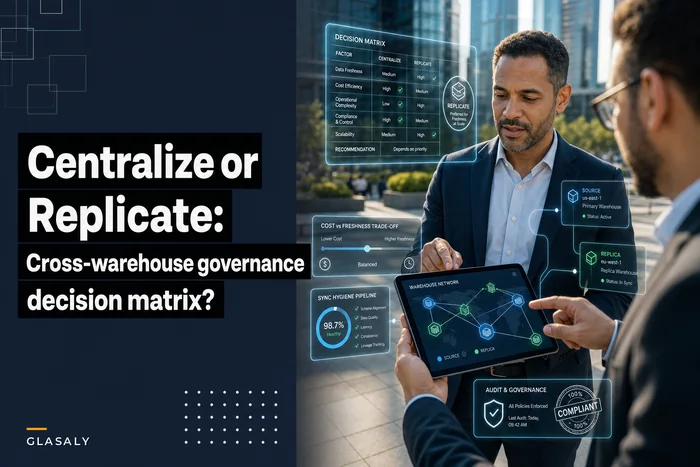
Multi-engine best-of-breed. Makes sense when you're mature, you can negotiate commitments, and different workloads genuinely benefit from different engines. Bad idea when you haven't solved governance across systems yet — which is its own decision covered in when to centralize vs replicate across warehouses. Best-of-breed without governance is just sprawl with a better vocabulary.
Stage-based sourcing checklists
Run through the list for your stage before signing anything.
Early stage:
-
Can one person operate this without being on-call?
-
Is spend capped or at least predictable?
-
Does it cover your Tier 2/3 needs without forcing a streaming purchase?
-
Can you export your data cleanly if you need to leave?
Growing stage:
-
Have you tiered your freshness needs and confirmed how few are truly Tier 0?
-
Does any self-managed component have more than one person who can fix it?
-
Is your ingestion vendor's freshness commitment written into the contract, not just the sales deck?
-
Do you have parity checks ready for any future migration?
Scaling stage:
-
Are you buying for your current stage or a hoped-for one?
-
Is the hot path isolated so a batch job can't starve a streaming workload?
-
Do you have a rollback map for every new component?
-
Have you modeled cost at 2x current volume, not just today's?
Mature stage:
-
Are commitments negotiated against realistic, not peak, usage?
-
Is governance solved before you add engines?
-
Does each engine earn its place with a measured workload benefit?
-
Is on-call coverage real and documented for every self-run system?
Run through the list for your stage before signing anything.
A real scenario
A regional e-commerce operation — roughly 40 people, one two-person data team — came in convinced they needed a full streaming platform to handle "real-time" order and inventory analytics. The proposed stack would have run them somewhere around $8k–$11k a month just in infrastructure, before anyone's time was factored in.
Working through the four variables told a different story. Their maturity was solidly Growing, not Scaling. When they tiered freshness honestly, exactly one use case — low-stock alerts during flash sales — needed anything close to Tier 0. Everything else was comfortable at hourly. And their operational capability was two people, neither of whom wanted to be paged at night for a streaming outage.
The defensible answer was a managed warehouse on predictable spend, hourly micro-batches for the operational dashboards, and one narrow managed streaming path for the stockout alerts only. Infrastructure came in closer to $3k–$4k a month, spend volatility dropped to near-flat, and both engineers could actually operate every part of it. About six months later, when they genuinely hit Scaling, they migrated the hot path using the parallel-run approach above — with a rollback window that, as it happened, they never needed to use.
The point isn't the savings, though those were real. It's that the architecture matched the business. When they grew, they grew into a bigger pattern on purpose, instead of having bought it prematurely and spent two years half-using it.
The system view: why this keeps breaking
Analytics platform sourcing goes wrong when it's treated as a technology choice instead of an operational one. The warehouse, the streaming path, the ingestion vendor, the people on call, the finance team watching the bill — these aren't separate decisions. They're one system, and the failure points cascade between them. Overbuy on freshness and you create operational load your team can't absorb. Under-invest in capability and your elegant architecture becomes a single point of human failure. Ignore cost volatility and finance yanks the budget mid-migration, stranding you between two systems.
The stage-based matrix works because it forces those connections into the open. You don't pick a pattern and hope your team can run it — you pick the pattern your current capability, freshness needs, and cost tolerance can actually support, and you write down the rollback path before you move. Then, as the business matures, you transition deliberately, one defensible step at a time. That's the difference between a platform you accumulated and one you actually chose.
The stage-based matrix works because it forces those connections into the open. You don't pick a pattern and hope your team can run it — you pick the pattern your current capability, freshness needs, and cost tolerance can actually support, and you write down the rollback path before you move. Then, as the business matures, you transition deliberately, one defensible step at a time. That's the difference between a platform you accumulated and one you actually chose.
Ready to elevate your business intelligence?
Join 2,500+ businesses leveraging Glasaly to drive smarter decisions, improve team alignment, and boost operational performance.