
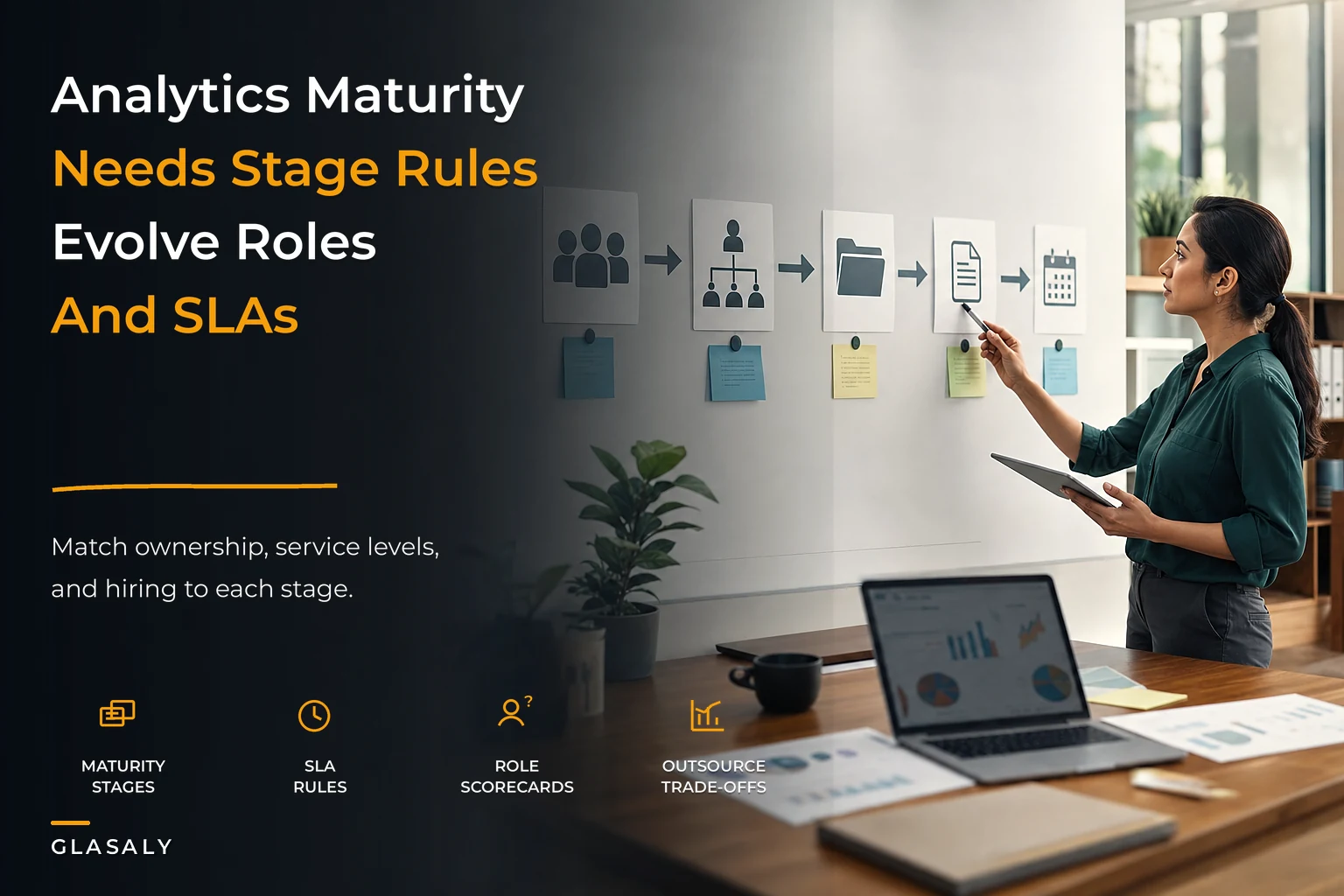

Most analytics functions don't fail because of bad tools. They fail because the operating model stays frozen while everything around it grows. A team that worked fine at five analysts and one warehouse suddenly can't keep up when there are forty stakeholders, three business units, and a CFO asking why the revenue number in the board deck doesn't match what's in Salesforce.
The uncomfortable truth is that the right structure at one stage is actively harmful at the next. A rigid SLA that protects a mature team will suffocate a scrappy two-person team. A shared-services model that keeps a 30-person org sane will feel like pointless bureaucracy to a startup. So the real question isn't "what's the best analytics operating model" — it's "what's the right model for where we are right now, and how do we we know when we've outgrown it."
This is a blueprint for exactly that. We'll walk through the maturity stages, what roles you actually need at each one, how shared-services responsibilities shift, how SLAs should tighten (and where they shouldn't), and the hiring-versus-outsourcing trade-offs that quietly determine whether the whole thing scales or collapses.
Why analytics teams outgrow their own structure
There's a pattern that shows up over and over. A company hires one analyst to "own data." That person does everything — pipelines, dashboards, ad-hoc pulls, executive decks, the occasional data-quality fire. It works, because the surface area is small and one brain holds the whole system.
Then the company grows. More stakeholders means more requests. More requests means the analyst becomes a bottleneck. So they hire a second analyst. Now there are two people, but no clear division of labor, so both get pulled into everything and neither owns anything cleanly. Metrics start drifting because there's no single definition owner. Two dashboards show two different churn numbers. Nobody notices for three weeks.
The structural failure here isn't headcount. It's that responsibilities were never reassigned as the team grew. The operating model stayed at "everyone does everything" long after that stopped being viable. The pain tends to arrive in predictable waves — and each wave corresponds to a maturity stage that demands a different shape.
The rest of this piece maps those stages so you can see the wave coming before it hits.
The four maturity stages at a glance
Before going deep, here's the shape of the whole progression. Think of these less as rigid categories and more as gravity wells your team drifts toward as it scales.
Stop missing critical business insights.
Glasaly helps you create, share, and track interactive dashboards effortlessly.
- Real-time data visualization
- Collaborative report sharing
- Customizable analytics widgets
No credit card required
| Stage | Team size (rough) | Primary job of analytics | Biggest risk | SLA posture |
|---|---|---|---|---|
| 1. Firefighter | 1–3 | Answer questions fast, keep the lights on | Key-person dependency | None formal; best-effort |
| 2. Builder | 3–8 | Standardize metrics and pipelines | Metric drift, request chaos | Loose SLAs on critical assets |
| 3. Service | 8–20 | Run analytics as an internal product | Coordination overhead | Tiered SLAs by asset criticality |
| 4. Platform | 20+ | Enable self-serve, govern at scale | Bureaucracy, slow delivery | SLOs + error budgets, automated enforcement |
The mistake most managers make is trying to jump two stages at once — usually because a new VP wants "enterprise-grade governance" imposed on a team that's still firefighting. That almost always backfires. You can't run tiered SLAs when you don't yet have a metric catalog. Structure has to earn its way in.
Stage 1: Firefighter — one brain, no ceremony
At this stage you have one to three people, and the honest goal is speed and trust. Leadership needs answers, and they need to believe the answers. Everything else is premature.
Minimal viable roles: One generalist analyst-engineer. That's it. This person writes SQL, builds the dashboards, wrangles the pipeline, and translates business questions. If you have a second or third hire, they're clones, not specialists.
Shared-services responsibilities: None, really. There's no "shared service" because there's nothing to share yet. The whole function is the shared service.
SLA reality: Don't write formal SLAs. A two-person team with a 24-hour freshness SLA on twelve dashboards will spend all its time managing the SLA instead of doing actual work. What you do need is one informal rule: critical numbers get checked before the Monday leadership meeting. That's your entire service commitment.
The real danger at Stage 1 isn't slow delivery — it's that everything lives in one person's head. When that analyst goes on vacation, the business goes blind. The single most valuable thing you can do here isn't hiring another person; it's writing down where things are. A one-page "if I get hit by a bus" doc listing every pipeline, every dashboard owner, and every credential location is worth more than a second analyst.
Stage 1 checklist:
-
[ ] One "system map" doc exists (pipelines, dashboards, data sources)
-
[ ] Credentials and access are documented somewhere other than one laptop
-
[ ] The 3–5 numbers leadership actually uses are identified and defined
-
[ ] There's a shared place (not DMs) where requests land
-
[ ] Someone other than the primary analyst can pull the critical numbers in a pinch
When to leave this stage: You know you've outgrown Firefighter when requests start colliding — two stakeholders want conflicting things in the same week and your one analyst has to negotiate priority instead of just doing both.
Stage 2: Builder — standardize before you scale
This is where most teams get stuck, and where the most damage gets done. You now have three to eight people, enough demand that firefighting doesn't cut it, but not enough structure to keep definitions consistent. The job of analytics shifts from answering to building the foundation that makes answers repeatable.
Minimal viable roles:
-
Analytics lead — owns priorities, definitions, and the roadmap. Half their job is saying no.
-
Analytics engineer(s) — own the transformation layer and data models.
-
Analyst(s) — own reporting, ad-hoc work, and stakeholder relationships.
The key move is separating the modeling work from the answering work. When the same person does both, the modeling always loses, because ad-hoc requests are louder. That's how you end up with a pile of one-off queries and no reusable foundation.
Shared-services responsibilities emerge here. For the first time, some things become "central and shared": the core data models, the definitions of your top metrics, the intake process. A useful early move is to pull metric-definition ownership out of individual analysts and make it a shared, versioned thing. This is also the stage where an intake process stops being optional — without one, whoever shouts loudest sets the roadmap. If you haven't built a real prioritization workflow yet, that's the highest-leverage fix at this stage.
SLA evolution: Now you introduce your first loose SLAs, but only on the assets that matter. Don't SLA everything. Pick your five to ten critical dashboards and pipelines and commit to something like: "critical dashboards refreshed by 7am, breakages acknowledged within a business day." Everything else is best-effort. The framework matters more than the specific numbers — a lightweight SLO framework for metrics and data-quality gives you a way to define "healthy" without drowning in formal contracts.
Hiring scorecard — Stage 2:
| Trait | Weight | Why it matters here |
|---|---|---|
| Range (can do modeling and reporting) | High | You can't afford narrow specialists |
| Comfort with ambiguity | High | Nothing is documented yet |
| Stakeholder communication | Medium | Requests come raw and vague |
| Deep specialization | Low | Premature at this size |
| Self-documenting habits | High | This is how you avoid Stage 1's trap again |
The classic Stage 2 mistake: hiring a specialist too early. A team of four does not need a dedicated data governance person or a dedicated BI developer. Specialists at this size sit idle in their lane while generalists drown. Hire people who can cover two or three roles until the volume genuinely justifies splitting them.
Stage 3: Service — analytics as an internal product
At eight to twenty people, coordination becomes the enemy. The work isn't harder; there's just more of it, and more people who need to agree on things. This is the stage where analytics has to stop being a group of helpful people and start being an actual service — with defined offerings, owners, and commitments.
Minimal viable roles now include real specialization:
-
Analytics manager — runs the operating model, not the queries.
-
Data platform / analytics engineers — own pipeline reliability and the semantic layer.
-
Embedded analysts — assigned to specific business units (sales, ops, finance) so they build domain depth.
-
A data-quality or governance owner — now this role earns its keep.
The shift toward embedding analysts into business units is the big unlock at this stage. Centralized analysts who serve everyone equally end up serving no one deeply. Embedded analysts learn the domain, anticipate needs, and cut request volume because they already know what sales actually means by "pipeline."
Shared-services responsibilities expand sharply. A clear split emerges between what's centralized (the platform, definitions, governance, tooling standards) and what's federated (domain reporting, analysis, stakeholder work). Getting this boundary right is basically the whole game at Stage 3. The full operating-model version of this — with lifecycle templates and role definitions — is worth studying in depth if you're formalizing analytics as an internal service with SLAs and roles.
SLA evolution — tiering appears. You now need tiered SLAs, because treating a board-level revenue dashboard the same as a one-off marketing report wastes effort in both directions. A workable tier structure:
-
Tier 1 (mission-critical) freshness by a set hour, incidents acknowledged within an hour, resolution target same-day.
-
Tier 2 (important) daily freshness, next-business-day acknowledgment.
-
Tier 3 (best-effort) no freshness guarantee, fixed when capacity allows.
The trap here is SLA inflation — every stakeholder insists their dashboard is Tier 1. If everything is Tier 1, nothing is. Someone senior has to hold the line and force ranking. A quick gut check: if a Tier 1 asset breaks and nobody would get paged on a weekend, it isn't actually Tier 1.
A real scenario
A mid-sized e-commerce operation had grown to about a dozen people on its data team, all centralized, all fielding requests from a shared queue. Turnaround on ad-hoc requests had crept up to roughly two weeks, and the finance team had quietly started building its own spreadsheets because waiting wasn't an option. Two "official" revenue numbers were now floating around the company.
They restructured into a Service model: three analysts embedded directly with sales, ops, and finance, a central team owning the models and definitions, and a three-tier SLA. Within about a quarter, ad-hoc turnaround on Tier 2 requests dropped to two or three days, the shadow spreadsheets faded because finance's embedded analyst was faster than doing it themselves, and — maybe most importantly — the dueling revenue numbers collapsed back into one, because definitions now had a single central owner. No new headcount. Same twelve people, different shape.
Stage 4: Platform — govern at scale without grinding to a halt
Beyond twenty people, the failure mode flips completely. At earlier stages you die from chaos; at this stage you die from bureaucracy. The whole point of Platform maturity is enabling other people to serve themselves safely, so the central team stops being a bottleneck for every question.
Minimal viable roles get properly differentiated: platform engineers, analytics engineers, a governance and standards function, embedded analytics teams per domain, and often an enablement role whose entire job is helping non-analysts self-serve correctly.
Shared-services responsibilities now center on paved roads — standardized, well-governed defaults that make the right way the easy way. The central team's job is no longer to answer questions; it's to make sure the hundreds of people answering their own questions are all pulling from consistent, trustworthy definitions.
SLA evolution — from SLAs to SLOs with error budgets. Instead of promising "99% uptime" as a rigid contract, you set service-level objectives with error budgets: a defined tolerance for how often freshness or quality can slip before the team stops shipping features and fixes reliability instead. Enforcement becomes automated — monitoring, alerting, and gates rather than humans manually checking. Human vigilance doesn't scale to hundreds of assets; the checks have to run themselves.
At this stage, the Platform model is doing its job when the central analytics team is boring. No fires, no heroics, no one-analyst-holds-all-the-context situations. Boring means the infrastructure works.
When Platform maturity is a bad idea: if you're forcing it before you have the demand to justify it. A 15-person org does not need error budgets and paved roads and an enablement team. Imposing Platform structure on a Service-stage team just adds process without adding value, and your best people will leave because the job got slow.
Hiring vs. outsourcing at each stage
The build-versus-buy question changes meaning as you mature, and getting it wrong is expensive in both directions.
Stage 1–2: Outsource infrastructure, hire judgment. A small team should not be hand-rolling a data warehouse or building custom ingestion. Use managed tooling and spend your scarce headcount on people who understand the business. Outsourcing the actual analysis at this stage rarely works — external contractors don't have the context to interpret your numbers, and you'll spend more time explaining than you would have spent doing it.
Stage 3: Selective outsourcing works for bounded, specialized projects — a one-time migration, a specific ML model, a governance framework setup. Keep the recurring, domain-heavy work in-house because that's where institutional knowledge compounds.
Stage 4: Outsourcing shifts toward capacity and specialization — burst capacity for big initiatives, or deep specialists you can't justify full-time. The core platform and governance stay in-house permanently; they're too central to rent.
A checklist for the outsource decision, at any stage:
-
[ ] Is this work recurring or one-time? (Recurring → lean toward hiring)
-
[ ] Does it require deep business context? (Yes → keep in-house)
-
[ ] Is it a specialized skill you'll use rarely? (Yes → outsource)
-
[ ] Would losing this capability hurt if the vendor disappeared? (Yes → build it)
-
[ ] Can you clearly specify the deliverable? (No → don't outsource; you'll waste months)
The common mistake is outsourcing the wrong layer — renting the judgment (your analysts) while building the commodity (your infrastructure). It should almost always be the reverse.
How to actually move between stages
Transitions are where teams stumble, because leveling up isn't a headcount event — it's a responsibility reassignment event. Here's a sane sequence for moving up a stage without breaking things.
-
Diagnose the current pain honestly. Are you drowning in chaos (need more structure) or drowning in process (need less)? These have opposite fixes and it's easy to misread which one you have.
-
Reassign one responsibility before adding one person. Often the fix is pulling metric ownership out of a generalist's lap, not hiring. Try the structural change first.
-
Introduce structure on the critical few, not the many. New SLAs, new governance, new tiers — apply them to your top assets first and expand only once they hold.
-
Document the new boundaries. Who owns what now? What's centralized, what's federated? Ambiguity here recreates the exact chaos you're trying to escape.
-
Set a review date. Structure decays. What fit six months ago won't fit next quarter. Put a recurring check on the calendar to ask "have we outgrown this shape?"
Here's a compact flow you can follow:
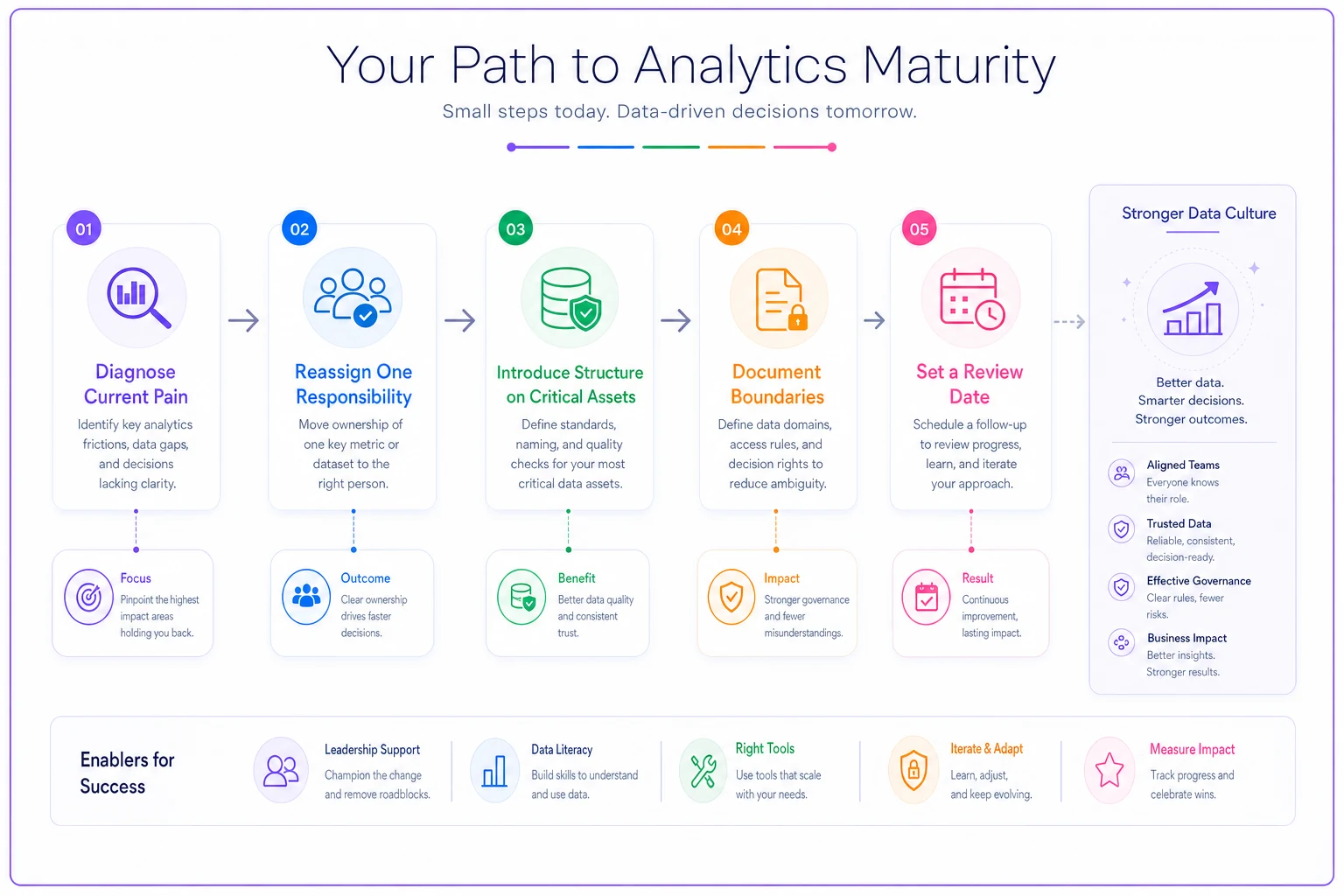
Use this as a checklist when you plan a structural change so you don't jump to hiring before responsibilities are clear.
The through-line
The single most useful mental model here: your analytics operating model should always be one notch simpler than you think it needs to be, and you should upgrade it one notch before you're forced to. Teams that impose heavy structure too early strangle themselves. Teams that wait too long to add it drown in inconsistency and shadow data.
Every stage in this blueprint trades one problem for another. Firefighters trade structure for speed. Platforms trade speed for consistency and scale. There's no stage that's simply "better" — there's only the stage that fits your current size, demand, and risk. The teams that scale cleanly aren't the ones with the best tools or the most people. They're the ones who noticed the wave coming and reshaped the boat before it hit.
The question to sit with isn't "how do we get to Stage 4." It's "which stage are we actually in right now, and what's the one responsibility we should reassign this quarter to be ready for the next one."
Ready to elevate your business intelligence?
Join 2,500+ businesses leveraging Glasaly to drive smarter decisions, improve team alignment, and boost operational performance.