



Most analytics teams treat adoption as a launch event. You ship the dashboard, run a training session, drop a link in Slack, and move on. Three months later, half the intended users are back in their old spreadsheets, the "single source of truth" has four competing versions, and someone in a leadership meeting pulls a number nobody recognizes.
The dashboards work fine. The models are accurate. The pipelines run on schedule. And yet the thing still didn't stick.
That gap—between technically-correct analytics and analytics that actually change how people work—is what analytics change management is supposed to close. But most of the advice out there treats it like a communication problem: better emails, more enthusiasm, an executive sponsor. In real operations, adoption fails for structural reasons, and those reasons repeat across almost every company that grows past a handful of analysts.
This is a systems article. Not a list of engagement tips. The goal is to show how curricula, meeting rituals, adoption KPIs, and onboarding playbooks connect into a repeatable machine—and where that machine breaks as headcount and dashboard count climb.
The real reason adoption stalls (it's not resistance)
The lazy explanation is "people resist change." Sometimes true. But when you actually watch how work flows through a team, the pattern is usually different: people don't have a repeatable path from a number to a decision.
A regional operations manager opens a dashboard, sees inventory turns dropped from around 6.2 to 5.4, and then… what? If the next step isn't obvious, the dashboard becomes a curiosity, not a tool. She goes back to the workflow she already trusts, because that workflow ends in an action she knows how to take.
This is why analytics adoption is fundamentally a process problem sitting on top of a people problem. The number needs a home in someone's day. It needs a moment where it gets looked at, a decision it's tied to, and a consequence when it's ignored.
-
Training teaches tools, not decisions. People learn how to filter a dashboard but not when to act on it.
-
No recurring moment forces the data into a conversation. If nobody is expected to reference the metric in a meeting, it goes unreferenced.
-
Ownership is fuzzy. The dashboard "belongs" to the data team, so operators feel like guests in it.
-
Success is measured by logins, not decisions. Vanity adoption metrics hide the fact that nobody's behavior changed.
Fix the tools and you've fixed nothing. The system has to make analytics the path of least resistance for the actual decision.
The four-part system that makes adoption repeatable
Think of adoption as four interlocking components. Miss one and the whole thing wobbles. Miss two and you're back to spreadsheets by Q3.
Stop missing critical business insights.
Glasaly helps you create, share, and track interactive dashboards effortlessly.
- Real-time data visualization
- Collaborative report sharing
- Customizable analytics widgets
No credit card required
| Component | What it does | What breaks without it |
|---|---|---|
| Repeatable curricula | Teaches decisions, not just navigation | People can read the dashboard but don't know when to act |
| Meeting rituals | Forces data into recurring decisions | Metrics get built, then ignored |
| Decision-linked KPIs | Measures whether behavior actually changed | Teams celebrate logins while nothing improves |
| Onboarding playbooks | Makes each new hire adopt by default | Adoption decays with every hire and reorg |
The magic isn't in any single piece. It's that each one covers the failure mode of the others. Rituals create demand for the curriculum. The curriculum makes people ready for the rituals. KPIs tell you whether either is working. Playbooks keep the whole thing alive as people churn.
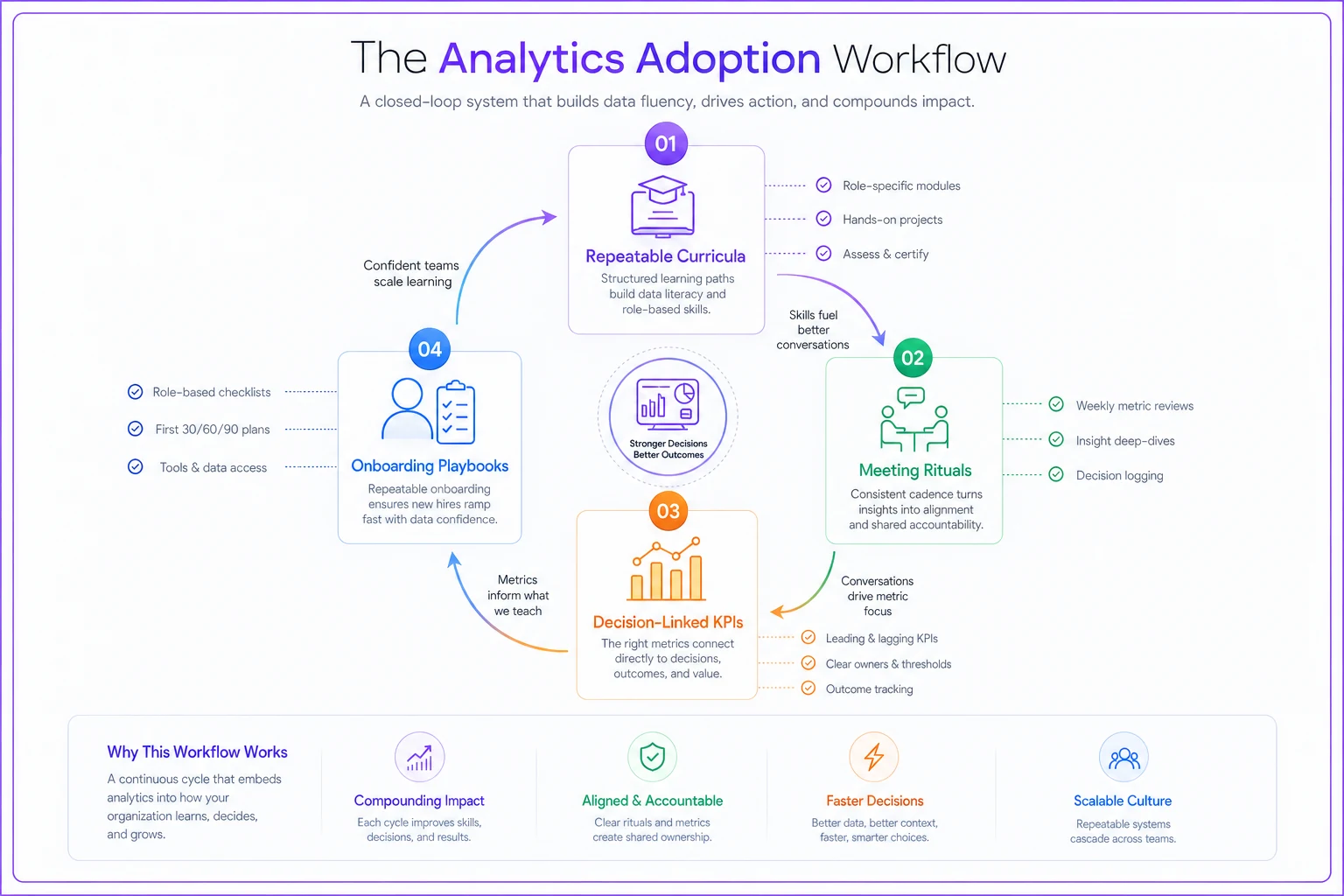
A simple diagram helps teams see how the four parts interlock in practice.
Curricula that teach decisions, not clicks
Most analytics training is built backwards. It starts with the tool—"here's the filter panel, here's how to export"—and never gets to the part that matters: what do I do when the number moves?
A repeatable curriculum is role-specific and decision-first. Instead of "how to use the sales dashboard," it's "how a territory rep decides which accounts to call this week using the dashboard." The tool navigation is a footnote inside a decision, not the headline.
-
Foundation (everyone, ~45 min) what the core metrics mean, where the definitions live, and who owns them. Not how to build charts—how to trust them.
-
Role tracks (per function, ~60–90 min) the two or three decisions this role makes with data, walked through with real recent examples. An ops lead gets a different track than a support manager.
-
Refreshers tied to change (as needed) when a metric definition changes or a new dashboard ships, a 15-minute update, not a full re-training.
The mistake teams make here is treating curriculum as a one-time onboarding artifact. It has to be repeatable—version-controlled, owned, and re-runnable every time a new cohort joins or a definition shifts. If your training deck is two reorgs out of date, people learn the wrong things and then distrust the data when it doesn't match.
The decision-first framing overlaps heavily with building role-specific decision playbooks for ops, sales and support—the curriculum is essentially how you teach those playbooks so they don't rot in a wiki.
Meeting rituals: where adoption actually happens
Training doesn't create adoption. Rituals do.
If a metric never appears in a recurring meeting, it doesn't matter how good the dashboard is. People act on what they're accountable for in front of their peers. That accountability lives in the calendar, not the curriculum.
A ritual is a recurring meeting with a fixed structure where specific metrics must be referenced and specific decisions must be made. The key word is fixed. If the format drifts, the discipline drifts with it.
-
Same time, same people, same dashboard open on screen. Not "someone's screenshot from Tuesday."
-
Owner walks the top three metrics and states whether each is on-track, watch, or off-track.
-
Every off-track metric gets a named owner and a next step, captured in the same place every week.
-
Last week's next steps get reviewed first. This is the part everyone skips, and it's the part that makes the ritual real. If nobody checks whether last week's action happened, the ritual becomes theater.
Make the meeting's agenda a shared doc with the dashboard embedded so owners can't move items off the list without a recorded next step.
The pattern in businesses that make analytics stick: the ritual is boring, consistent, and slightly uncomfortable. Someone has to say "this number is off and it's mine." That discomfort is the engine. Remove it—by letting people report vibes instead of numbers—and adoption quietly dies while the meeting continues to exist.
One more thing worth noting. Rituals fail when the metric on screen doesn't match the decision on the table. If your weekly ops meeting reviews metrics that nobody in the room can influence, people tune out. The ritual's metrics must map to the room's authority. A store-manager meeting should show store-level levers, not company-wide margins they can't touch.
Decision-linked adoption KPIs (stop counting logins)
This is where most adoption measurement falls apart. Teams measure logins, dashboard views, or "active users" and declare victory. Those numbers tell you people opened something. They tell you nothing about whether a decision changed.
Adoption KPIs should measure the link between the data and the action. Harder to measure—far more honest.
-
Decision coverage of the recurring decisions this role makes, what percentage now reference the agreed metric? You can measure this by auditing meeting notes, not tracking clicks.
-
Metric reference rate in decisions how often do documented decisions cite the canonical dashboard versus an ad-hoc pull or a gut call?
-
Time-to-first-action when a metric goes off-track, how long until a named owner takes a step? Faster response means the data is actually in the workflow.
-
Definition disputes per quarter how often does a meeting get derailed by "that's not the right number"? Declining disputes signal trust is building.
-
Shadow-spreadsheet count roughly how many parallel tracking sheets still exist for metrics you've centralized? This one is uncomfortable and extremely revealing.
Good adoption KPIs are leading indicators of behavior, not lagging indicators of activity. A login is activity. A decision that cites the dashboard and gets reviewed next week is behavior.
Watch out for the trap of measuring what's easy. Login counts are sitting right there in the tool. Decision coverage requires you to actually read meeting notes and tag them. The easy metric is the one that lies to you.
Onboarding playbooks: adoption that survives turnover
Here's the failure that catches teams by surprise. You run a great rollout. Adoption climbs. Everyone's using the dashboards. Then, over the next year, a third of the team turns over, two teams reorg, and adoption slowly decays—not because anyone rejected it, but because the new people never went through the rollout.
Adoption isn't a state you reach. It's a state you maintain against constant churn. Onboarding playbooks are how you maintain it without re-running the whole rollout every time.
-
Which dashboards matter for their role, and which to ignore. New hires drown in dashboards. Tell them the three that matter.
-
The two or three decisions they own that use data, with a walkthrough.
-
Which rituals they attend and what's expected of them there.
-
Where definitions live and who to ask when a number looks wrong.
-
A 30-day check can they run their core decision using the canonical data without help?
Worth stealing: bake analytics onboarding into the role onboarding, not a separate "data training" that gets skipped when someone's busy. If learning the sales dashboard is step four of becoming a sales rep, it happens. If it's an optional lunch-and-learn, it doesn't.
This connects directly to running analytics as a service rather than a project. When you turn analytics into an internal service with SLAs, roles and lifecycle templates, onboarding playbooks become one of the standing deliverables of that service—not a scramble every time headcount changes.
What breaks at scale
Everything above works reasonably well with one team and five dashboards. The interesting failures start when you grow.
At ~5 dashboards and one team: informal adoption works. Everyone sits near each other, the analyst answers questions verbally, definitions live in people's heads. You don't need this system yet—but this is exactly when you should start building it cheaply.
At ~30 dashboards and four teams: the informal layer collapses. Definitions drift between teams. Two departments report "revenue" differently and don't know it. Rituals exist in some teams and not others, so adoption is patchy and invisible. This is where most companies first feel the pain and mistake it for a tooling problem.
At ~100 dashboards and many teams: without a system, you get metric sprawl, competing sources of truth, and a data team buried in "why don't these two numbers match" tickets. Adoption becomes impossible to even measure, let alone improve, because there's no shared definition of what people are supposed to be adopting.
The through-line: the four-part system doesn't just improve adoption—it's what keeps adoption legible as complexity grows. Curricula scale training. Rituals scale accountability. KPIs scale measurement. Playbooks scale onboarding. Skip building them early and you'll be retrofitting them under fire during a reorg, which is the worst possible time.
When this system makes sense—and when it doesn't
When it's worth the effort: you have multiple teams making recurring decisions, dashboards that are technically fine but underused, or a history of "we built it and nobody used it." If your analytics quality is high and adoption is low, this is your gap.
When it's overkill: a five-person startup where everyone reads the same dashboard over coffee. You don't need meeting rituals and onboarding playbooks for a team that fits at one table. Building this heavy a system too early is its own waste—you'll spend energy maintaining process that a Slack message could handle.
Who should be careful: teams whose underlying data quality is shaky. If your numbers can't be trusted yet, forcing adoption just spreads distrust faster. Fix the trust layer first—definitions, ownership, accuracy—then build adoption on top. Ritualizing a metric people don't believe in makes the meeting worse, not better.
A real scenario
A mid-sized regional distributor—around 80 employees, four branches—had built a solid set of operational dashboards over the course of a year. Inventory, fill rates, branch margins, the works. Technically excellent. Barely used.
Branch managers still ran their weeks off personal spreadsheets. When corporate asked about a margin dip, everyone pulled different numbers and the meeting turned into an argument about whose figure was right instead of what to do about it.
They didn't build new dashboards. They built the system around the existing ones. A short role-specific curriculum for branch managers focused on three weekly decisions. A fixed Monday branch ritual where each manager walked the same three metrics and last week's action items got reviewed first. Adoption measured by decision coverage and definition disputes instead of logins. And a two-page onboarding playbook so new branch managers plugged in from week one.
The change wasn't instant. Over roughly two quarters, the number of parallel spreadsheets dropped sharply, and the "whose number is right" arguments—which used to eat a chunk of every review—mostly disappeared. Off-track metrics started getting a named owner and a next step within the same week instead of drifting. Nothing about the data changed. What changed was that the data finally had a place in how people actually worked.
Analytics doesn't stick because it's accurate. It sticks because there's a repeatable path from a number to a decision, a recurring moment that forces that decision into the open, an honest way to measure whether behavior changed, and a way to bring every new hire into the fold before adoption decays.
Curricula, rituals, KPIs, and playbooks aren't four separate initiatives—they're one system where each part covers the others' weak spots. Build them lightly when you're small, deliberately as you grow, and you avoid the quiet death that catches most rollouts around month three.
The teams that get this right stop treating adoption as a launch and start treating it as an operating discipline. That shift—from event to system—is the whole game.
Ready to elevate your business intelligence?
Join 2,500+ businesses leveraging Glasaly to drive smarter decisions, improve team alignment, and boost operational performance.