



There's a strange asymmetry in most companies. When product wants to build a feature, there's a whole gauntlet: specs, estimates, roadmap review, sometimes a finance sign-off. But when someone wants to define a new North Star metric or spin up a whole measurement program around retention, it usually happens over Slack and a hastily approved dashboard request. Nobody attaches a dollar figure. Nobody asks what decision this metric will change. And six months later you have forty "critical" KPIs, three of which anyone actually looks at.
The gap isn't measurement quality. Teams generally know how to build good metrics. The gap is that measurement gets treated as free. It isn't. Every metric carries a cost — pipeline maintenance, dashboard upkeep, the cognitive load of one more number in the exec deck, and the very real risk that people optimize for the wrong thing because the incentive got wired to a bad measure. An enterprise measurement strategy that doesn't route these choices through the same funding discipline as everything else will drift, sprawl, and eventually lose credibility with finance entirely.
This article is about closing that gap. Not with more governance meetings, but with a system: proposals that come with finance-ready ROI artifacts, approval flows weighted by who actually has skin in the game, funding gates that force real prioritization, and incentive designs that don't quietly reward gaming. The goal is simple — make a new metric something you fund, not something you file.
## Why measurement keeps escaping the budget conversation
Finance funds things it can reason about. A hire has a salary. A tool has a license fee. A campaign has a spend and a target CAC. Measurement work slides past all of this because the cost is diffuse and the benefit is fuzzy.
In practice, this usually plays out one of a few ways. A product manager decides the team needs an "activation score." An analyst builds it. It requires three new events, a nightly job, and a semantic layer definition. None of that shows up as a line item — it gets absorbed into existing headcount. The true cost stays invisible until the data team is drowning and someone asks why the warehouse bill doubled.
Then there's the incentive problem, which tends to be the more expensive one. Once a metric gets attached to a bonus, an OKR, or a board slide, it stops being a neutral observation and becomes a target. Targets get gamed. A support org measured purely on ticket close time will close tickets fast and reopen rates will quietly climb. A sales team measured on pipeline created will create garbage pipeline. The measurement choice created a financial outcome nobody modeled.
These two problems compound on each other. Because measurement isn't funded, nobody owns the full cost. Because nobody owns the cost, incentives get wired to metrics that were never stress-tested. And because the incentives are live, killing a bad metric becomes politically hard — someone's comp depends on it now.
The fix isn't to slow everyone down with process. It's to give measurement the same artifacts every other investment gets, so the conversation with finance becomes normal instead of awkward.
## The core idea: a metric proposal is an investment proposal
Reframe every significant measurement request as a small business case. Not a novel — a one-pager that a finance partner could skim and either fund, defer, or reject with actual reasoning.
Stop missing critical business insights.
Glasaly helps you create, share, and track interactive dashboards effortlessly.
- Real-time data visualization
- Collaborative report sharing
- Customizable analytics widgets
No credit card required
-
What decision does this metric change? If nobody's behavior changes based on this number, it's a vanity metric wearing a lab coat.
-
Who is accountable for the metric and its consequences? Not "the data team." A named owner on the business side.
-
What does it cost to build and maintain? Build hours, ongoing pipeline cost, review overhead.
-
What's the expected return, and how will we know? Framed as avoided cost, captured revenue, faster decisions, or reduced risk.
-
What could go wrong if this gets gamed? The failure mode when someone optimizes hard for it.
That last question is the one everyone skips and the one finance secretly cares about most. A metric proposal that names its own gaming risk is far more credible than one that pretends the number is neutral.
This also connects to how you should already be structuring your measurement. If you've built out a prioritized KPI hierarchy that links strategy to measurement, a new proposal shouldn't be a free-floating idea — it should slot into an existing branch of that hierarchy or explicitly justify why it deserves a new one. Proposals that can't find a home in the hierarchy are usually the ones that shouldn't exist.
## The ROI scorecard: what finance actually wants to see
The centerpiece artifact is an ROI scorecard. It doesn't need to be precise to be useful — it needs to be defensible. A rough, honest estimate beats a spuriously exact one every time.
Here's the structure that tends to survive contact with a skeptical CFO:
| Field | Example entry | Why finance cares |
|---|---|---|
| Metric name & owner | Onboarding completion rate — owned by Head of Product | Accountability has a name |
| Decision it drives | Whether to fund onboarding redesign in Q3 | Ties spend to an actual choice |
| Build cost (one-time) | ~60 analyst hours + 2 new event streams | Real labor, not "free" |
| Run cost (annual) | Roughly $4k–$6k in pipeline + storage | The recurring bill nobody budgets |
| Expected return | ~2–3 pt lift in activation → est. $180k–$240k ARR retained | Framed in money, with a range |
| Confidence | Medium — based on one prior cohort test | Honest uncertainty builds trust |
| Gaming risk | Teams could mark steps "complete" without real usage | Names the failure mode upfront |
| Kill condition | Drop if unused in 2 consecutive planning cycles | Every metric gets an exit |
Two things make this work in practice. First, the range on expected return. Nobody believes a single number like "$217,000 in retained ARR." A range with a stated confidence level reads as thoughtful rather than sales-y. Second, the kill condition — a pre-agreed trigger under which the metric gets retired. Metrics almost never die on their own. Building the exit into the proposal is how you prevent sprawl from quietly returning.
If your organization already runs some version of an analytics funding model, this scorecard should feel familiar. It's the same discipline described in the pragmatic analytics funding model with ROI scorecards for teams, applied at the level of individual measurement decisions rather than whole teams.
## Stake-weighted approval: not everyone's vote counts equally
Most approval processes fail in one of two directions. They either require sign-off from everyone (so nothing moves) or from one person (so bad metrics slip through because that person didn't have full context).
Stake-weighted approval routes the decision to the people who actually bear the consequences. The weighting is simple: the more your outcomes depend on the metric — or the more it costs you to maintain — the heavier your voice.
A practical weighting looks like this:
-
The consequence owner (whoever's comp, OKR, or roadmap the metric will influence) — heaviest weight. If they don't buy in, the metric will be resented and quietly ignored.
-
The finance partner — heavy weight on cost and ROI realism, light weight on the technical build.
-
The data/analytics owner — heavy weight on feasibility, run cost, and lineage risk.
-
Adjacent teams affected by the incentive — moderate weight, mostly as a veto on gaming risk they can see and you can't.
The point isn't bureaucracy. A metric attached to sales comp needs sales leadership and finance and the analyst who has to maintain it — but it probably doesn't need marketing's blessing. A metric feeding a board risk report has the opposite stakeholder map. Match the approvers to the stakes and approvals get both faster and safer.
One pattern worth flagging: when the same person is both the consequence owner and the proposer, require a second independent approver focused specifically on gaming risk. That's the situation where a metric gets designed to be easy to hit rather than useful to have.
## Funding gates: staging measurement like any other project
Not every metric deserves full production investment on day one. Gates let you fund measurement in stages, killing weak ideas cheaply before they become permanent infrastructure.
A workable three-gate flow:
Gate 1 — Exploration (small, fast). Someone gets a fixed budget of hours to prototype the metric in an ad-hoc environment. No production pipeline, no dashboard polish. The only deliverable is: does this number behave the way we think, and does it correlate with anything that matters? Most metric ideas should die here, cheaply.
Gate 2 — Validation (conditional funding). The metric graduates to a proper definition, gets a semantic-layer entry and lineage, and runs alongside real decisions for a defined window — say a quarter. It's watched but not wired to anyone's incentives yet. This is the stage most teams skip, and it's exactly the stage that catches gaming risk and definitional drift before real money rides on it.
Gate 3 — Production & incentive attachment. Only now does the metric enter exec packs, OKRs, or comp. By this point it has an owner, a cost model, a track record, and a kill condition. Attaching incentives to a metric that hasn't cleared Gate 2 is how you end up rewarding the wrong behavior for a full performance cycle before anyone notices.
The gate structure also forces honest prioritization. When there's a fixed exploration budget each cycle, teams have to argue for which measurement bets are worth the slots. That scarcity does more for focus than any governance policy. If you want a rigorous way to rank competing measurement work against everything else on the data team's plate, the impact-scoring matrix for prioritizing analytics debt works well as the intake filter feeding Gate 1.
Visualizing the three gates can help align stakeholders quickly.
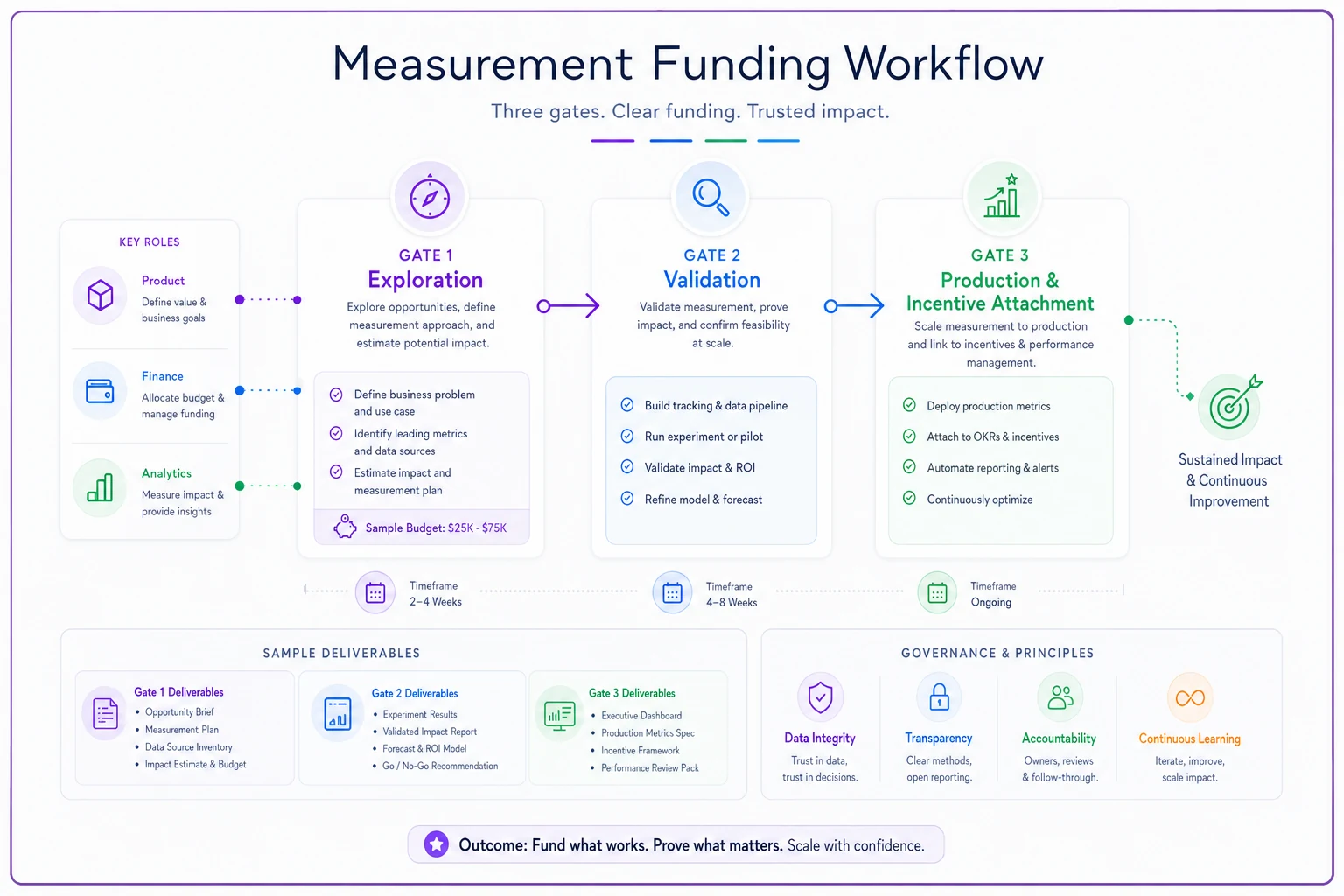
Keep exploration budgets small and fixed each cycle to force prioritization.
The gate structure also forces honest prioritization. When there's a fixed exploration budget each cycle, teams have to argue for which measurement bets are worth the slots. That scarcity does more for focus than any governance policy. If you want a rigorous way to rank competing measurement work against everything else on the data team's plate, the impact-scoring matrix for prioritizing analytics debt works well as the intake filter feeding Gate 1.
## Incentive design: the part everyone gets wrong
Even a well-funded, well-vetted metric can do real damage the moment you attach a reward to it. This is consistently the section teams under-invest in and regret later.
A few design patterns that hold up:
-
Pair every incentive metric with a guardrail metric. Never reward ticket close time without watching reopen rate. Never reward pipeline created without watching win rate on that pipeline. The guardrail is what stops the gaming.
-
Reward the trend, not the snapshot, early on. Snapshots invite one-time manipulation. Sustained movement over multiple periods is harder to fake and more meaningful anyway.
-
Cap the upside on any single metric. If hitting one number pays out unbounded, people will sacrifice everything else to hit it. Diminishing returns above a target keeps behavior balanced.
-
Keep a lag between metric introduction and incentive attachment. This is Gate 2 restated — let a metric run "unpriced" long enough to see how people react before money is involved.
The uncomfortable truth is that the cleaner and simpler a metric is, the easier it usually is to game. A single crisp number in a comp plan is a magnet for shortcuts. Composite measures and guardrail pairs are harder to explain but far harder to distort.
## A real scenario: the mid-size SaaS that funded its metrics
A B2B SaaS company around 180 employees had accumulated what their VP of Analytics called "metric debt." Roughly 50 dashboards, an exec pack with about 30 KPIs, and a sales incentive tied to a "qualified pipeline" metric that finance quietly didn't trust.
The problem showed up in the numbers. Reported qualified pipeline was growing nicely — up around 40% year over year — while actual closed revenue barely moved. Sales was hitting its incentive on a metric that had drifted into meaninglessness. Meanwhile the data team was spending an estimated 30–40% of its time maintaining dashboards nobody opened.
They didn't rebuild everything. They introduced the proposal-and-gate system for any new metric, then applied the ROI scorecard retroactively to the existing exec pack. About a third of those 30 KPIs failed to name a decision they drove and got retired. The qualified-pipeline metric went back to Gate 2 — pulled off comp temporarily — and got paired with a guardrail on stage-conversion rate. Within two quarters the reported-versus-closed gap narrowed sharply, mostly because reps stopped being rewarded for stuffing the top of the funnel.
The maintenance win was quieter but real. Killing the dead dashboards freed up roughly a day and a half a week of analyst time, which went back into the exploration gate — funding the next round of measurement bets instead of babysitting the last one.
## When this system makes sense — and when it doesn't
This isn't free overhead, and forcing it everywhere is its own kind of failure.
When it clearly makes sense:
-
You have metrics attached to compensation, OKRs, or board reporting.
-
Metric sprawl is already real and dashboards outnumber the decisions they support.
-
Finance and product routinely disagree about whether measurement work is worth it.
-
You're past the stage where a founder can hold every metric in their head.
When it's a bad idea:
-
You're a small team still finding product-market fit. Heavy gating on a 10-person startup will strangle the exploration you actually need.
-
The metric is genuinely exploratory and has zero incentive or reporting weight — let people experiment.
-
You'd use the process as a political weapon to block other teams rather than to allocate honestly.
Who should not do this: any organization that isn't willing to actually retire metrics. If proposals go in but nothing ever gets killed, you've just added paperwork to sprawl. The kill conditions and the Gate 2 discipline are the whole point. Without the willingness to say no and to sunset live metrics, the system becomes theater.
## Making it stick
The lightweight version of all this fits on a page. A shared proposal template with the five questions. A scorecard with a return range and a kill condition. A stakeholder map that assigns approval weight by stake. Three gates with fixed exploration budgets. And an incentive checklist that refuses to attach a reward without a guardrail.
The deeper shift is cultural. Once measurement runs through funding discipline, a few things change on their own. People propose fewer metrics but defend them better. Finance stops seeing analytics as a cost center it can't reason about and starts treating measurement as a portfolio of small bets with returns. And the exec pack slowly shrinks to the numbers that actually change decisions — which was always the point.
None of this requires a heavy tool or a reorg. It requires treating a new metric the way you'd treat any other request for money: with a case, a cost, an owner, and an exit. Do that consistently and measurement stops being the one part of the business that escapes the budget conversation.
Ready to elevate your business intelligence?
Join 2,500+ businesses leveraging Glasaly to drive smarter decisions, improve team alignment, and boost operational performance.