



Every data catalog looks great in month one. Someone champions the rollout, a handful of enthusiastic analysts document their most-used tables, and the launch deck shows 60% coverage. Then the champion moves to another project, the "document your datasets" Slack reminder stops going out, and by month six half the descriptions say "TODO" and nobody trusts the ownership column anymore.
The catalog didn't fail because the tool was bad. It failed because nobody built a system for keeping it fresh once the initial excitement wore off. Documentation is unpaid work that competes with everything else on an analyst's plate, and unpaid work always loses.
This is the part of a data catalog adoption playbook that nobody wants to write, because it's not about features. It's about behavior — who updates what, when, why they'd bother, and how you catch rot before it spreads.
The decay pattern nobody plans for
Catalog rot doesn't happen all at once. It creeps in through a predictable sequence, and if you know the sequence you can put a tripwire on each stage.
-
Launch surge. Everyone documents their pet tables. Coverage jumps fast — maybe 55–70% of high-traffic datasets get a description in the first three weeks.
-
The long tail stalls. The boring tables — staging models, one-off exports, that revenue table with 90 columns — never get touched. Coverage plateaus.
-
Drift begins. A column gets renamed in a dbt model. The catalog still shows the old name. Nobody notices for a while.
-
Trust erosion. An analyst pulls up a table description, it's wrong, they mutter "figures," and they go ask a person instead. Now the catalog has lost that user.
-
Abandonment. Once enough people route around the catalog, it becomes a graveyard. Updating it feels pointless because nobody reads it.
The insight most teams miss: the danger stage is #4, not #2. Incomplete coverage is annoying but survivable. A single confidently-wrong description does more damage than ten missing ones, because it teaches people not to trust the whole thing. Protect accuracy before you chase completeness.
Contributor KPIs that don't backfire
The obvious move is to measure "number of datasets documented per person" and put it on a leaderboard. Don't. That metric produces exactly what you'd expect — a flood of low-effort, technically-present descriptions like "This table contains order data" that satisfy the counter and help no one.
Stop missing critical business insights.
Glasaly helps you create, share, and track interactive dashboards effortlessly.
- Real-time data visualization
- Collaborative report sharing
- Customizable analytics widgets
No credit card required
What works better is measuring outcomes closer to actual usage, and keeping the number of tracked metrics small enough that people can hold them in their head.
| KPI | What it actually tells you | Why the obvious alternative fails |
|---|---|---|
| Coverage of top 50 queried tables | Are the datasets people actually use documented? | Raw coverage % rewards documenting dead tables |
| Description freshness (days since last verified) | Is the info still trustworthy? | "Number documented" ignores rot entirely |
| Orphaned datasets (no owner assigned) | Where does accountability disappear? | Total dataset count hides the gaps |
| Search-to-no-result rate | What are people looking for and not finding? | Coverage % can't see demand |
The freshness metric is the one most teams skip, and it's the most important. A description with a "last verified" date older than 90 days on a heavily-queried table should show up on a report — not because the description is definitely wrong, but because nobody has looked at it recently enough to vouch for it.
One pattern worth stealing: tie the freshness clock to query volume, not calendar time. A table queried 400 times a week needs verification far more often than one queried twice a month. Ranking staleness by usage keeps your review effort pointed where the risk actually is.
Incentive design: making documentation pay for itself
Intrinsic motivation carries a catalog for about a quarter, then fades. You need incentives that survive after the novelty does. A few designs that hold up:
-
Attach ownership to on-call, not to volunteering. If someone owns a dataset, they field the questions about it. The path of least resistance for a repeat question becomes "write it in the catalog once" instead of answering it in Slack for the fifth time. Documentation becomes the lazy option, which is exactly what you want.
-
Make the catalog the source, not a copy. If people have to update definitions in two places, they'll update one. When your semantic layer or dbt descriptions feed the catalog automatically, contribution stops being a separate chore.
-
Credit in performance reviews, quietly. Not a leaderboard. A manager noting "Priya's dataset docs cut support questions on the finance schema" in a review does more than any gamified points system, because it signals the work is actually seen.
-
Small friction removal beats big rewards. A $25 gift card for documenting tables feels nice once. A one-click "verify this is still accurate" button that takes four seconds gets used every week.
The mistake teams make repeatedly: over-investing in extrinsic rewards (contests, prizes, public rankings) and under-investing in removing friction. Contests spike activity for two weeks and then it flatlines below where it started, because people learn to document for the contest rather than because it's easy and useful.
Lightweight review cycles that people actually run
Heavy governance reviews die on contact with a busy quarter. The trick is making review cycles so small they're hard to skip.
The 15-minute weekly triage. Once a week, whoever's on data on-call pulls a single auto-generated report with three lists: newly created datasets with no description, stale-but-high-traffic descriptions, and orphaned datasets. They don't fix everything. They spend fifteen minutes assigning owners and knocking out the two or three most urgent items. That's it.
The monthly ownership sweep. A short async check: does every dataset in the top-100-by-usage list have a living owner? People change teams, and orphaned ownership is where accountability quietly evaporates. This ties directly into treating datasets like products with clear lifecycles — the same discipline covered in making datasets product-ready with contracts and a retirement path. A catalog and a dataset-contract practice reinforce each other; the catalog is where the contract becomes discoverable.
The quarterly retirement pass. Look at datasets with zero queries in 90 days and flag them for deprecation. A catalog that never removes anything becomes a junk drawer. Retiring dead entries is as important as adding new ones — it keeps search results clean and trust high.
A simple visual of the weekly triage → monthly sweep → quarterly retirement cycle can help teams align on who does what.
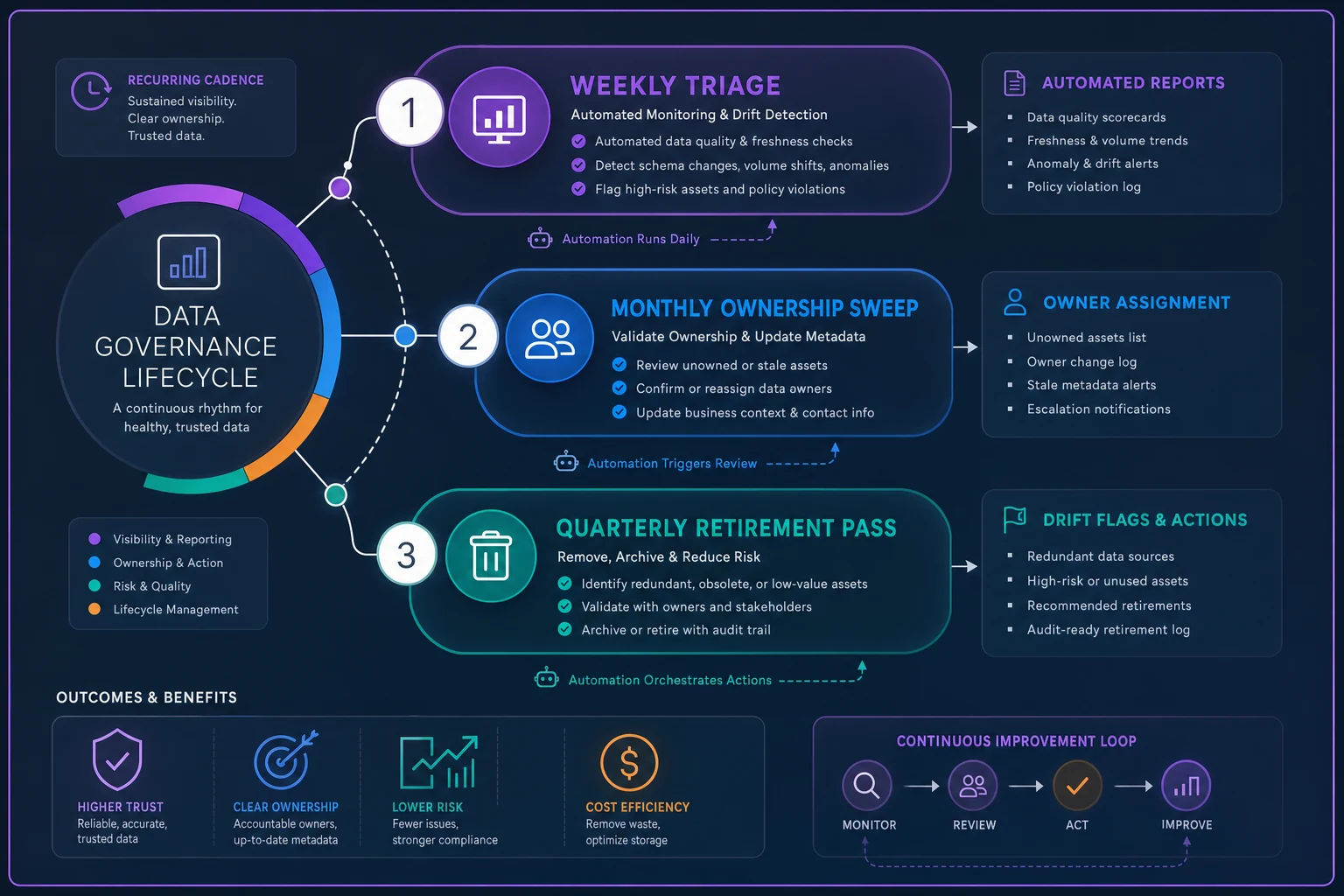
The reason these work is pacing. Weekly for urgent decay, monthly for accountability, quarterly for cleanup. Each cycle only touches the slice of the catalog that matters at that cadence, so no single review ever feels overwhelming.
Where automation does the boring 80%
Humans should make judgment calls. Machines should handle everything mechanical, and there's a lot of mechanical work in catalog upkeep that quietly eats hours if you do it by hand.
-
Auto-populate structural metadata. Column names, types, row counts, last-updated timestamps, upstream lineage — none of this needs a human. If your catalog isn't pulling these automatically from the warehouse, you're paying analysts to transcribe things a script can read.
-
Draft descriptions from existing sources. Pull dbt model descriptions, column comments, and PR history to generate a first-draft description. A human verifies and edits — that's a 30-second review instead of a blank-page task. This is where AI automation earns its place: it drafts, a person confirms. The confirm step is what keeps quality up.
-
Flag drift automatically. When a schema changes and a documented column disappears or gets renamed, the catalog should raise a flag, not silently show stale info. This single automation kills stage #3 of the decay pattern before it reaches the trust-erosion stage.
-
Route stale items to owners. Instead of a central person nagging everyone, an automated weekly digest sends each owner only their stale, high-traffic entries with a one-click verify link.
A useful rule of thumb: automate detection and drafting, keep humans on verification and judgment. The failure mode on the other extreme — fully auto-generated descriptions with no human check — produces catalogs that are complete and useless, full of "column amt contains amt values" tautologies. Automation should shrink the human's job, not eliminate the human.
When heavy process is the wrong move
Not every team needs this whole machine, and forcing it where it doesn't fit wastes goodwill.
When a lightweight, automation-heavy approach makes sense: teams of five or more analysts, more than a few hundred active tables, and multiple people querying datasets they didn't build. That's when the cost of asking-a-person exceeds the cost of maintaining docs.
When it's overkill: a two-person data team where everyone knows every table. You'll spend more time maintaining the maintenance system than you save. A shared doc and good column comments in dbt are plenty until you outgrow them.
Who should NOT build a gamified contributor program: teams where documentation is already patchy and trust is already low. Adding points and contests to a distrusted catalog just adds noise. Fix accuracy on the top-20 tables first, rebuild trust, then worry about incentives. Order matters — trust before scale.
A real scenario: mid-size ecommerce analytics team
A retail analytics team — about 9 analysts supporting an ecommerce operation — had rolled out a catalog the previous year. Coverage looked fine on paper, around 65%, but people had stopped using it. The recurring complaint was that descriptions were wrong often enough that nobody trusted them, so they kept pinging the two senior analysts, who were fielding maybe 25–30 catalog-type questions a week between them.
They changed three things over about two months. First, they narrowed KPIs to freshness and top-50 coverage instead of raw count. Second, they wired the catalog to pull dbt descriptions automatically and added drift flags on schema changes. Third, they ran the 15-minute weekly triage on the existing on-call rotation.
The measurable shift wasn't in coverage — that actually dropped on paper to around 58% once they retired dead tables. But repeat questions to the senior analysts fell to roughly 8–10 a week, and the "last verified" dates on the top-50 tables stayed under 30 days for the first time. The senior analysts got back somewhere around half a day each per week. The catalog went from something people avoided to something they checked first, mostly because they could finally trust what it said.
Worth noting: their old number went down while the thing that mattered went up. If they'd been chasing coverage %, they'd have called it a regression.
The maintenance checklist
Print this, or paste it into whatever your team actually reads:
-
[ ] KPIs measure freshness and top-queried coverage, not raw documented count
-
[ ] Every top-100 dataset has a named, currently-employed owner
-
[ ] Structural metadata (schema, lineage, row counts) is auto-populated, not hand-typed
-
[ ] Schema drift raises a flag instead of silently showing stale descriptions
-
[ ] Freshness clock is weighted by query volume, not calendar days
-
[ ] A weekly 15-minute triage runs on an existing rotation, not a new meeting
-
[ ] Dead datasets (zero queries in 90 days) get flagged for retirement quarterly
-
[ ] Documentation is the easy path for repeat questions, not extra work
-
[ ] Auto-drafted descriptions always get a human verification step
Print this, or paste it into whatever your team actually reads:
Closing thought
A catalog is less a project and more a habit, and habits need structure or they fade. The teams that keep theirs alive aren't the ones with the fanciest tooling — they're the ones who made contribution the low-friction option, put a tripwire on drift, and kept their review rituals small enough that a busy quarter couldn't kill them. Start with accuracy on the tables people actually use, automate the boring transcription, and let the incentives quietly make documentation the lazy choice. Do that and the catalog stops being a launch you have to relaunch, and becomes something people reach for without thinking about it.
Ready to elevate your business intelligence?
Join 2,500+ businesses leveraging Glasaly to drive smarter decisions, improve team alignment, and boost operational performance.