

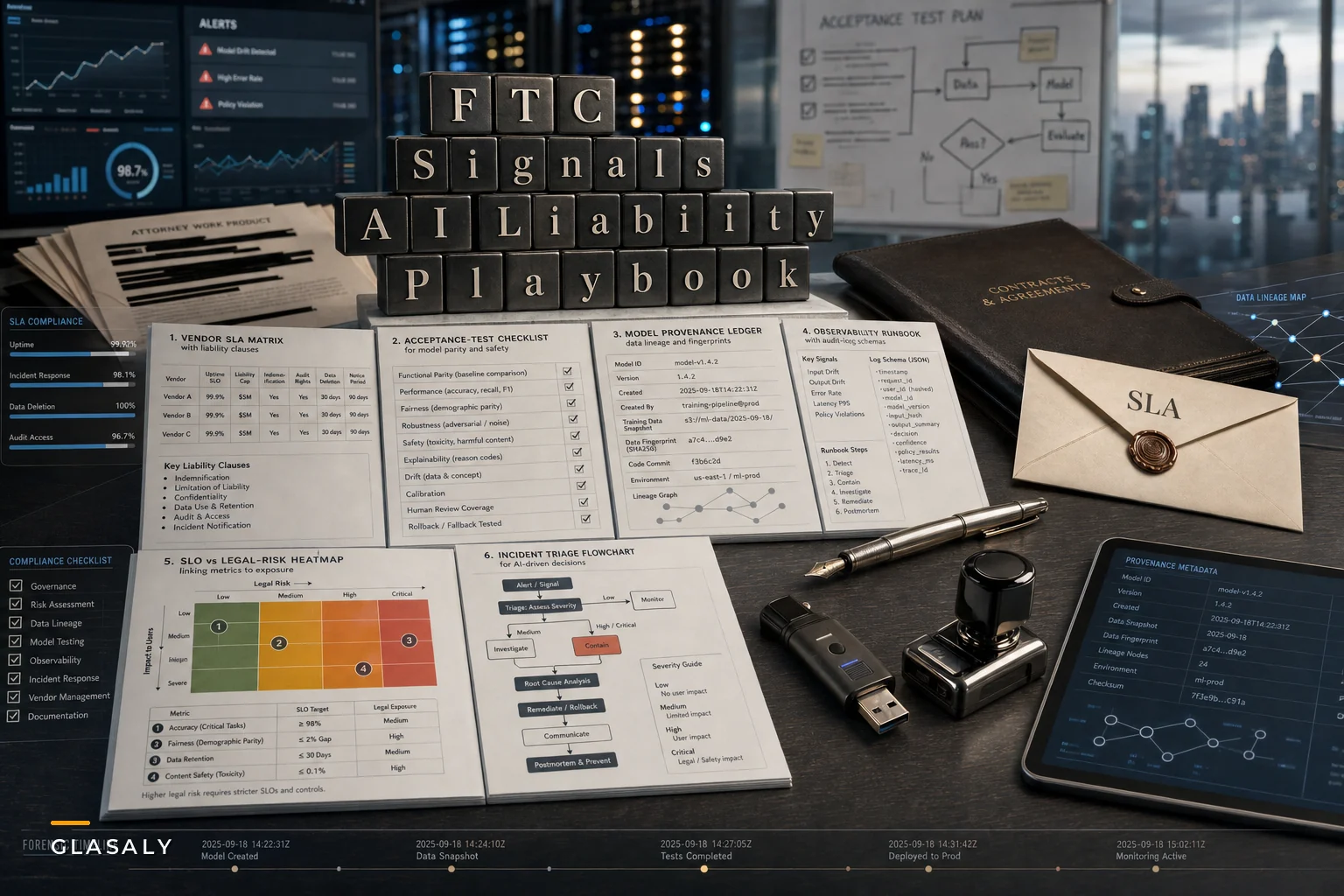

When the FTC chair pushed back on treating AI agents as independent actors — arguing that developers should carry liability for what their AI systems do — most coverage framed it as a consumer chatbot story. For anyone running an analytics function, that framing misses the point. The comments, reported by Reuters on September 25, 2026, are really about where responsibility lands when an automated system produces an output someone relied on.
If your analytics work includes AI-driven transforms, automated anomaly detection, or any tooling that generates "insights" on its own, you're somewhere in that liability chain. Not necessarily as the developer — but as the operator who deployed the thing into a decision workflow.
That's the part worth sitting with. Not the headline. The plumbing underneath it.
The real exposure isn't the model — it's the handoff
Most teams read a regulatory signal like this and assume the risk lives inside the AI model. It doesn't. The risk lives in the moment an automated output crosses into a human decision without anyone being able to explain how it got there.
Think about where AI already sits inside a typical analytics stack. Automated data-quality checks flagging anomalies. An "explain this metric change" feature in your BI tool. Maybe a transform using an LLM to categorize free-text support tickets into revenue-impact buckets. Maybe a vendor's forecasting module quietly updating demand predictions that feed procurement.
Each of those is an AI-driven step. And each one creates a question that didn't really exist five years ago: if that output was wrong and someone acted on it, who's accountable — and can you reconstruct what happened?
The FTC signal matters because it pushes that question from "nice to have" to "you'd better have an answer." When liability starts attaching to AI conduct, regulators and plaintiffs' attorneys both want the paper trail. If your analytics team can't produce one, the exposure doesn't evaporate — it defaults to whoever can't prove they weren't negligent.
And honestly, a lot of AI governance in analytics is theater. There's a policy doc nobody reads, an approval checkbox nobody validates, and a quiet assumption that the vendor "handles compliance." None of that holds up when someone asks you to show your work.
What the underlying problem actually is
Strip away the legal framing and you're left with a provenance problem. AI liability and analytics governance isn't some new discipline — it's the old discipline of metric lineage and reproducibility, now applied to outputs you didn't write by hand.
Stop missing critical business insights.
Glasaly helps you create, share, and track interactive dashboards effortlessly.
- Real-time data visualization
- Collaborative report sharing
- Customizable analytics widgets
No credit card required
With a traditional SQL transform, you open the query, read the logic, explain the number. With an AI-driven transform, the logic is partly inside a model you didn't build, trained on data you didn't see, behaving differently across versions you may not even be notified about. The chain of reasoning that used to be inspectable is now a black box sitting in the middle of your pipeline.
That's the gap. Your governance was built for deterministic logic. Your pipeline now contains non-deterministic components. And the regulatory environment is starting to assume you've closed that gap when, for most teams, it's wide open.
The teams that handle this well aren't the ones with the fanciest AI tooling. They're the ones who treated AI outputs exactly like an external data vendor — with contracts, acceptance tests, and logs — rather than treating them like a magic feature that just works.
The six moves, in priority order
Below is how I'd sequence this starting from a realistic place — meaning you have AI sprinkled through your stack and no formal governance around it yet.
1. Inventory every AI-driven step in your pipeline first
You cannot govern what you haven't mapped. Before anything else, walk the pipeline and list every place an AI or automated-insight component touches data or produces an output a human might act on.
Most teams are surprised here. A finance analytics group you'd expect to have two or three AI touchpoints usually turns up seven or eight once you count the "smart" features buried in BI tools, the auto-categorization in the data warehouse, and the vendor modules nobody remembers enabling.
For each one, record:
-
What it does and what decision it feeds
-
Whether the output is advisory or auto-applied
-
Which vendor or model version is behind it
-
Whether anyone currently reviews its output
That last column is usually the uncomfortable one.
2. Classify outputs by decision impact, not by how "cool" the feature is
Not every AI output carries the same risk. An LLM that drafts a dashboard description is low-stakes. An automated model that adjusts credit limits, reorders inventory, or flags accounts for collections is a different animal entirely.
Use a simple tier system:
| Tier | What it touches | Governance requirement |
|---|---|---|
| High | Money, contracts, customers, compliance reporting | Full audit log, human sign-off, acceptance tests, vendor SLA |
| Medium | Internal forecasts, prioritization, resource allocation | Logging, periodic review, drift monitoring |
| Low | Descriptive text, formatting, exploratory suggestions | Light logging, no formal review needed |
The mistake most people make is applying heavy governance evenly across everything, which burns the team out and gets quietly abandoned within a quarter. Concentrate effort where the liability actually sits.
3. Build an audit log that captures inputs, version, and output together
If liability attaches to AI conduct, the single most valuable thing you can have is a reconstructable record. For every high-tier AI step, you want to answer: what went in, which model version processed it, what came out, and who (if anyone) acted on it.
-
Timestamp and trigger — when it ran and why
-
Input snapshot or hash — enough to reproduce or prove what it saw
-
Model/version identifier — the specific vendor model and version
-
Raw output — before any downstream formatting
-
Downstream action — what decision or record it influenced
-
Reviewer — who validated it, if the tier required it
Store audit logs in immutable, access-controlled storage to make reconstruction straightforward during an investigation.
If your current tooling can't produce this, that's not a minor gap. That's exactly what a regulator or opposing counsel asks for first, and "we don't log that" is not an answer you want to give.
The diagram below shows the core steps — inventory, classification, logging, testing, contract updates, and incident response — and how they hand off between analytics, vendors, and decision owners.
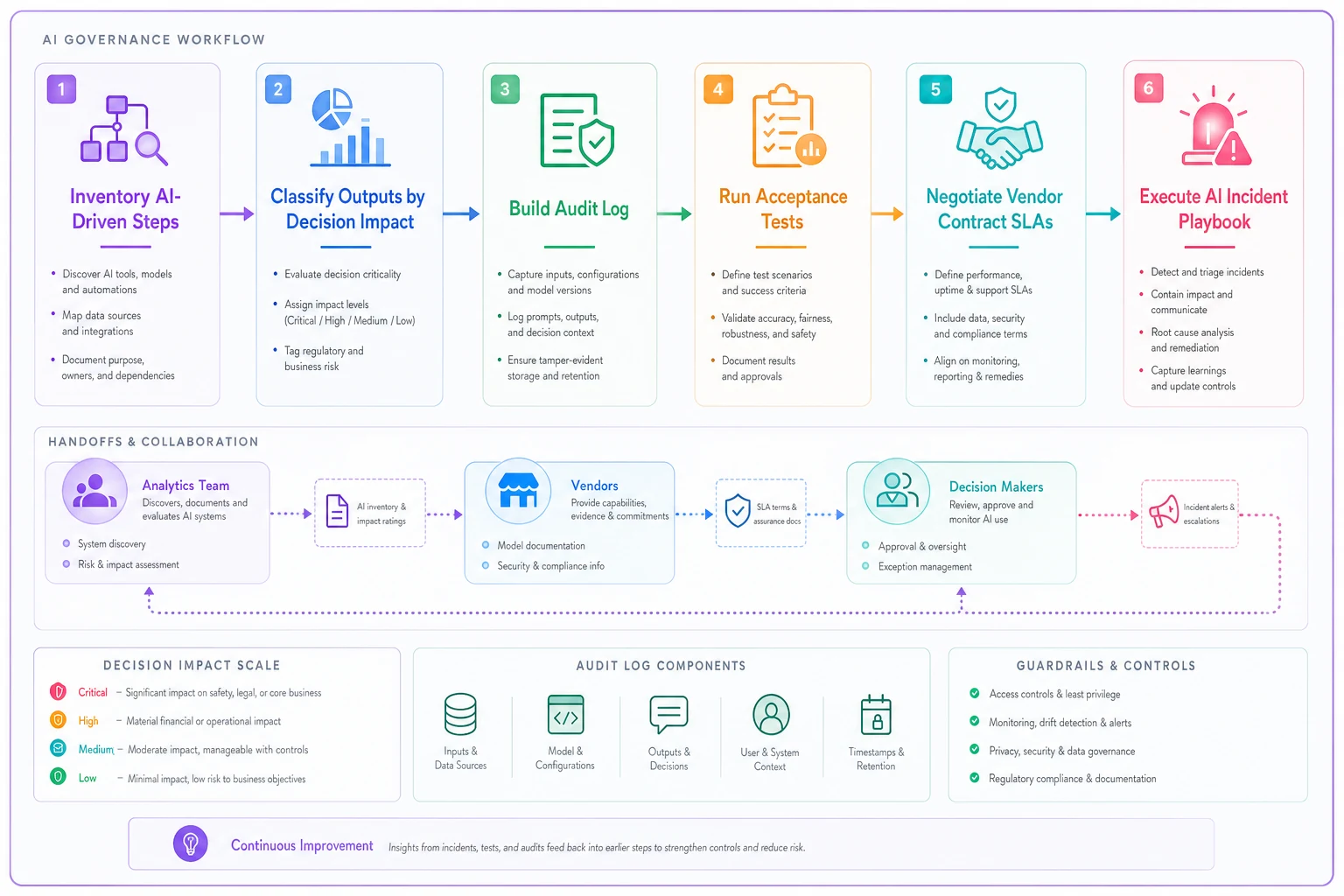
A visual like this helps align teams on who does what when an AI-driven output enters a decision path.
4. Write acceptance tests for AI outputs the way you'd test a data feed
Deterministic data gets schema checks, freshness checks, range validation. AI outputs need the same discipline, adapted for non-determinism.
-
The output falls within an expected distribution or value range
-
It never produces disallowed categories or obviously invalid values
-
Its error rate against a labeled sample stays below a threshold
-
Its behavior hasn't drifted significantly since the last version
Run these on a schedule and on every vendor version change. The point isn't perfection — it's having a documented, repeatable check that proves you were monitoring output quality rather than blindly trusting it. That distinction is essentially the difference between "reasonable care" and "negligence" in most liability frameworks.
5. Push the risk back into vendor contracts — this is non-negotiable now
This is where the FTC signal hits procurement directly. If developers may carry liability for their AI's conduct, your vendor agreements need to reflect that before something goes wrong, not after.
Most analytics vendor contracts were written for deterministic software. They promise uptime and support. They say almost nothing about model behavior, version-change notification, output accuracy, or who's liable when an AI feature produces a harmful result. That silence used to be tolerable. It isn't anymore.
The clauses worth demanding extend the same thinking behind metric contract clauses, freshness SLAs, and acceptance tests you'd already want from any data vendor — just applied to AI-specific risks:
-
Version-change notification with a defined lead time, so you aren't surprised by a silent model update that breaks your acceptance tests
-
Provenance and explainability commitments — what the vendor will disclose about training data, model logic, and output reasoning
-
Output-quality SLAs tied to measurable error rates on your use case, not a generic benchmark
-
Audit-log access so you can pull the records regulators will ask for
-
Clear liability allocation for harms caused by the vendor's AI behaving as designed versus your misuse of it
-
Incident cooperation obligations — the vendor helps you reconstruct what happened during an investigation
One thing worth noting: vendors will resist the liability clause hardest. That resistance is itself information. A vendor unwilling to stand behind their AI's conduct is telling you how confident they are in it.
6. Stand up an incident playbook specifically for AI outputs
When a regular metric breaks, you have a runbook. When an AI output causes a bad decision, most teams improvise — which is exactly what you don't want on record during a dispute.
An AI-output incident playbook should define:
-
Detection — how you learn an AI output was wrong (acceptance test failure, downstream complaint, drift alert)
-
Containment — how you pause or roll back the affected AI step without taking down the whole pipeline
-
Reconstruction — pulling the audit log to establish what the model saw and produced
-
Notification — who internally and externally needs to know, and when
-
Remediation — correcting downstream decisions that relied on the bad output
The teams that recover cleanly from these incidents are the ones who practiced the reconstruction step before they needed it.
A realistic picture of what good looks like
Consider a mid-sized distribution company with a lean analytics team — four people — that had quietly layered AI into a few places: automated demand forecasting from a vendor module, LLM-based categorization of inbound supplier emails, and an anomaly detector on margin reports.
Before any governance, the exposure looked like this: the forecasting module updated predictions with no version tracking, and procurement acted on those numbers directly. When a forecast ran hot for roughly three weeks and they over-ordered on a slow SKU category, nobody could say whether the vendor had changed the model or whether the input data had shifted. The post-mortem took the better part of a week and ended in a shrug — around $40k in excess inventory with no clear accountability.
After working through the inventory, adding audit logging on the high-tier forecasting step, and negotiating a version-notification clause into the renewal, the next time the forecast drifted, the acceptance test caught it within two days. The log showed a silent model update on the vendor's side, and the contract clause meant the conversation about who owned the cost was short rather than a weeks-long standoff. Not dramatic in a slide-deck sense — just the difference between "we don't know" and "here's exactly what happened."
When heavy AI governance is overkill
This cuts both ways. If your AI usage is genuinely low-stakes — descriptive text generation, exploratory suggestions, formatting help — building a full audit-and-SLA apparatus around it is wasted effort. You'll create process nobody follows, which is worse than no process because it creates a false sense of coverage.
The honest test: would anyone ever make a consequential decision based on this output? If no, govern it lightly and move on. If yes — especially if money, customers, or compliance reporting are involved — the six moves above aren't optional hygiene. They're the thing standing between your team and being the default holder of risk nobody else wanted to own.
Where this is heading
Regulatory signals like the FTC chair's comments rarely stay signals for long. They tend to show up eighteen months later as audit expectations, contract norms, and the baseline a court uses to judge whether you acted reasonably. Teams that treat AI outputs with the same provenance discipline they already apply to metrics and data feeds won't have to scramble when that shift lands.
The work isn't glamorous. It's inventory, logging, tests, and contract language — the unsexy backbone of any analytics function that intends to survive scrutiny. AI liability in analytics governance won't ultimately be decided by how sophisticated your models are. It'll be decided by whether you can calmly show your work when someone asks.
The work isn't glamorous. It's inventory, logging, tests, and contract language — the unsexy backbone of any analytics function that intends to survive scrutiny. AI liability in analytics governance won't ultimately be decided by how sophisticated your models are. It'll be decided by whether you can calmly show your work when someone asks.
Ready to elevate your business intelligence?
Join 2,500+ businesses leveraging Glasaly to drive smarter decisions, improve team alignment, and boost operational performance.