



Most analytics teams carry debt they've never actually measured. Brittle dashboards, hardcoded joins, a semantic layer that disagrees with itself, three "temporary" tables from 2022 that half the finance reports now depend on. Everyone knows it's there. Nobody can tell you what it costs, when it comes due, or what breaks first.
That's the actual problem. Not that the debt exists — all working systems accumulate it — but that it sits in a flat Jira list labeled "tech debt" with no structure. A flat list behaves like a credit card you only pay the minimum on. The balance never moves, interest compounds quietly, and one day a small change triggers a cascade that eats a week of incident response.
This post is about borrowing a specific idea from finance: technical debt amortization analytics. Instead of treating debt as a vague cleanup wishlist, you score each item by business risk, assign it an amortization window, budget capacity against it like a line item, and schedule actual "retirement" events tied to ROI and runway. It's boring in the best way. Boring is what makes it survive quarterly planning.
Why the "tech debt backlog" never shrinks
The usual failure isn't laziness. It's that debt and features compete in the same backlog, and features always win because they're legible to the people funding the work. A stakeholder can see a new cohort dashboard. They can't see the removal of a fragile upstream dependency. So the dependency stays, and stays, and stays.
Analytics debt doesn't have uniform interest rates. Some of it is genuinely inert — an ugly query that runs once a quarter, works fine, nobody touches. Paying that down is pure waste. Other debt is actively compounding: a metric definition duplicated across four tools, drifting a little further apart every month, so every exec review burns 20 minutes reconciling numbers that should match.
When you throw both into one backlog and sort by "priority: high/medium/low," you lose the single most important signal — velocity of harm. A medium-severity item that gets worse every week will outrun a stable high-severity item. Priority labels can't express that. A debt score can.
Score debt by business risk, not by how annoying it is
Engineers tend to rank debt by how much it irritates them to work around. Wrong axis. The axis that matters is: if this fails or keeps degrading, what does it cost the business, and how soon?
Stop missing critical business insights.
Glasaly helps you create, share, and track interactive dashboards effortlessly.
- Real-time data visualization
- Collaborative report sharing
- Customizable analytics widgets
No credit card required
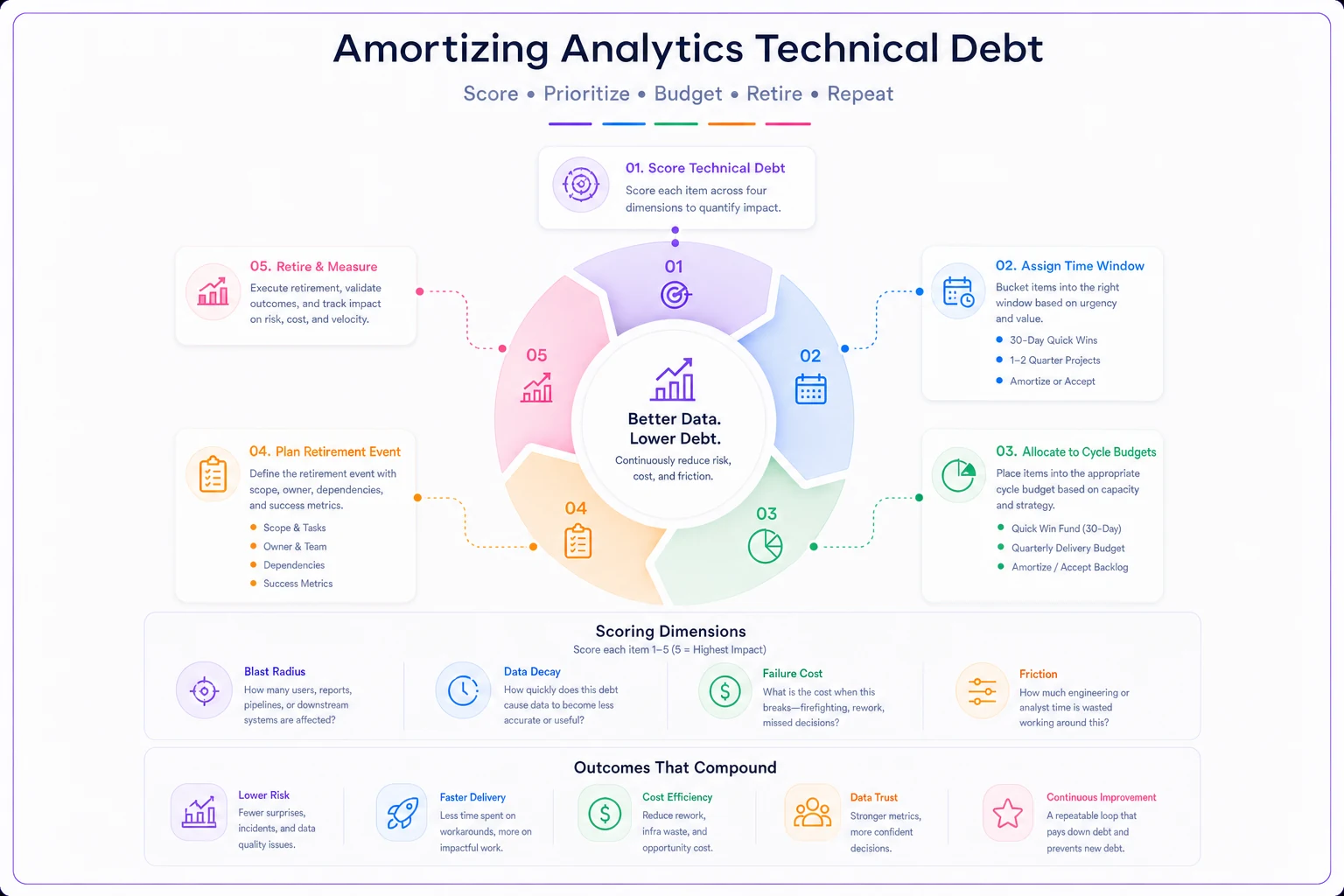
A workable score combines four factors. You don't need precision — you need consistency, so the same item scored by two different people lands in roughly the same band.
| Factor | What you're measuring | Low (1) | High (5) |
|---|---|---|---|
| Blast radius | How many downstream reports/decisions depend on it | One ad-hoc query | Board + finance + ops dashboards |
| Decay rate | How fast it's getting worse | Stable for a year | Drifts every refresh |
| Failure cost | What a breakage actually costs | Analyst reruns it | Wrong number in an exec decision |
| Fix friction | Effort + coordination to retire it | One analyst, one afternoon | Cross-team, needs backfill + comms |
Multiply blast radius × decay rate × failure cost, then divide by fix friction. High numbers are items that hurt a lot, spread wide, worsen fast, and are cheap to kill. Those jump the line. It's the analytics equivalent of a high-interest, low-balance card — pay it first.
The insight most teams miss: low fix friction should promote an item, not just high severity. A medium-risk item you can retire in an afternoon often delivers more risk reduction per hour than a scary item that needs a two-month migration. If you're building a scoring model from scratch, our impact-scoring matrix for analytics debt covers the prioritization mechanics in more depth.
Assign amortization windows so debt has a due date
Scoring tells you order. Windows tell you when. This is the step almost everyone skips, and it's the one that makes the whole thing real.
Every scored item gets an amortization window — the period over which you'll fully retire it. Think of it like a loan term: a short window means aggressive paydown, a long window means you're spreading it out because it's not urgent or too expensive to kill in one shot.
A simple three-tier structure works:
-
30-day window — actively compounding, high blast radius. The duplicated-metric-drift type. These get scheduled into the very next cycle.
-
One-to-two quarter window — real debt, stable-ish, needs coordination. Semantic layer cleanups, consolidating three overlapping pipelines into one.
-
Amortize-or-accept — low score, low decay. You either slot a thin slice into slack time or you formally accept it and stop pretending you'll fix it. Accepting debt on purpose is underrated. It clears the backlog of noise so the real items stay visible.
Teams that assign windows consistently retire 2–3x more debt per quarter than teams working from an unordered list — not because they work harder, but because a due date forces the item into an actual plan instead of a someday-pile.
A quick workflow diagram for assigning windows and scheduling retirements:
Teams that assign windows consistently retire 2–3x more debt per quarter than teams working from an unordered list — not because they work harder, but because a due date forces the item into an actual plan instead of a someday-pile.
Budget capacity like a line item
Debt paydown that depends on "leftover sprint capacity" never happens, because there's never leftover capacity. The fix is to make debt a fixed percentage of each cycle's budget — a non-negotiable line item, same as you'd budget a loan payment before discretionary spending.
-
Decide a debt budget percentage — most teams land somewhere between 15% and 25% of capacity per cycle, depending on how deep the hole is. New teams with clean systems can run lower. Teams drowning in it should run higher temporarily.
-
Convert the percentage into concrete slots — if a cycle has roughly 20 analyst-days and you set 20%, that's about 4 days earmarked for retirements. Put it on the board as real tickets, not an intention.
-
Fill the slots by score, respecting windows — pull the highest-scoring items whose windows are closing. The 30-day items get first claim.
-
Protect the budget — the moment a feature request eats the debt slots "just this once," the whole system collapses. This is the hardest rule to hold and the most important.
-
Report what you retired — close the loop with ROI so funders see the payoff.
The budgeting discipline is really an operating-model question — debt retirement works far better when analytics runs as a service with explicit capacity commitments, which we broke down in turning analytics into an internal service.
Debt retirement rituals (and why they beat continuous cleanup)
Continuous background cleanup sounds virtuous but tends to evaporate. Rituals — scheduled, named, visible events — survive. There's something about putting "Debt Retirement Day" on a calendar that makes it actually happen.
Name the ritual on the calendar and assign an owner to increase follow-through.
A retirement ritual in practice:
-
A recurring cadence — end of each cycle, or a half-day every two weeks.
-
A fixed agenda
pick from the scored list, retire the items, verify nothing downstream broke, mark them closed.
-
A short writeup per retired item — what it was, what it cost to keep, what retiring it freed up.
-
One number reported out
risk retired this cycle, roughly quantified.
One checklist worth handing a team starting this:
-
[ ] Every debt item has a score (risk × decay × cost ÷ friction)
-
[ ] Every item has an amortization window or is explicitly marked "accepted"
-
[ ] A fixed % of each cycle is reserved and visible on the board
-
[ ] A recurring retirement ritual exists on the calendar with an owner
-
[ ] Retired items get a one-line ROI note tied to runway impact
-
[ ] Accepted debt is reviewed quarterly in case its decay rate changed
The ritual does something the backlog can't — it creates a moment where retirement is the only job. No competing feature work. People actually finish things.
A real scenario
A mid-size ecommerce ops team — around 6 analysts supporting marketing, finance, and merchandising — had a backlog sitting at roughly 140 open tech debt tickets. They'd closed maybe a handful in months. The exec dashboards disagreed with the finance system often enough that leadership had quietly stopped trusting either.
They scored the backlog over two afternoons. Most of it — close to 90 items — turned out to be low-decay noise they formally accepted and archived. That alone changed the mood; the list went from overwhelming to around 45 items that actually mattered. The metric-drift problem scored at the top: high blast radius, worsening monthly, moderate friction to fix.
They reserved about 20% of each cycle and ran a half-day retirement ritual every two weeks. Within roughly a quarter they'd retired the drift issue — consolidated four definitions into one source — killed two of the three "temporary" 2022 tables, and cut their monthly reconciliation time from somewhere around 6–8 hours to under an hour. The qualitative win mattered as much as the hours: exec reviews stopped opening with "why don't these numbers match?"
Nothing dramatic. No heroic migration. Scored debt, real windows, protected budget, and a ritual that forced the work to actually happen.
When this makes sense — and when it doesn't
This whole approach is overhead. For a two-person analytics setup with a clean, young stack, formal amortization is premature. Just fix things as you go and revisit when the backlog crosses the point where you can't hold it in your head — usually somewhere north of 30–40 real items.
It's also a bad fit if leadership won't protect the debt budget. Without that commitment, you'll score and schedule beautifully and then watch every slot get eaten by feature pressure. In that case, the higher-leverage move is making the cost of debt visible to funders first — a recurring report showing hours lost to reconciliation and incidents — and earning the budget before building the machinery.
And don't amortize debt that's genuinely inert. The temptation to clean things because they're ugly is real. If an item has a near-zero decay rate and tiny blast radius, accepting it permanently is the correct call. Spending retirement capacity on tidy-for-tidy's-sake is just a different flavor of the same waste you're trying to eliminate.
Analytics debt isn't a cleanup problem, it's a cash-flow problem. Treated as a flat backlog, it compounds silently and never gets paid. Treated as financialized debt — scored by risk, given due dates, funded as a protected line item, and retired in scheduled rituals — it becomes something you manage deliberately instead of something that manages you. The teams that get this right aren't the ones with the least debt. They're the ones who know exactly what theirs costs and exactly when they're paying it down.
Ready to elevate your business intelligence?
Join 2,500+ businesses leveraging Glasaly to drive smarter decisions, improve team alignment, and boost operational performance.